PPE stands for Personal Protective Equipment.
It is the gear a worker wears to reduce exposure to a hazard at work. A hard hat, safety glasses, gloves, earplugs and a respirator are all PPE. PPE does not remove the hazard. It puts a barrier between the worker and the hazard.
Quick Reference
| Item | Detail |
|---|---|
| Short form | PPE |
| Full form | Personal Protective Equipment |
| Type | Initialism — say the letters: “pee-pee-ee” |
| What it is | Equipment worn by one person to reduce exposure to a hazard |
| Where you see it | Workplaces, hospitals, construction sites, labs |
| Not PPE | Everyday clothes, ordinary weather gear |
Pronunciation
PPE is pronounced “pee-pee-ee” — say the letters one by one, not as one word.
Acronym or Initialism?
PPE is an initialism, not an acronym (in strict terms). An acronym is read as a word — like NASA, read as “nasa”. An initialism is read letter by letter — PPE is read as “pee-pee-ee”, not as a word. People often use “acronym” loosely for both, so you may see PPE called an acronym elsewhere, but the exact term is initialism.
PPE Offices
PPE has no offices of its own, because it is a generic term for a class of equipment, not a single organisation. There is no PPE headquarters or network of PPE offices to list. The rules for PPE in the United States are set by OSHA — see the live OSHA post — but OSHA is the regulator, not a PPE office, so no office list is added here.
What Is PPE?
PPE is any equipment worn to minimize exposure to hazards that cause serious workplace injuries and illnesses. That is OSHA’s definition, in simple words: if a job can hurt you, and the hazard cannot be fully removed, PPE is what protects your body while you work.
PPE protects only the person wearing it. A hard hat does not make a falling object safe for everyone on site. It protects the head of the person wearing it. That limit is why PPE is called a last resort: first, remove the hazard if you can, or put a barrier between workers and the hazard. Wear PPE when those steps are not enough on their own.
Types of PPE
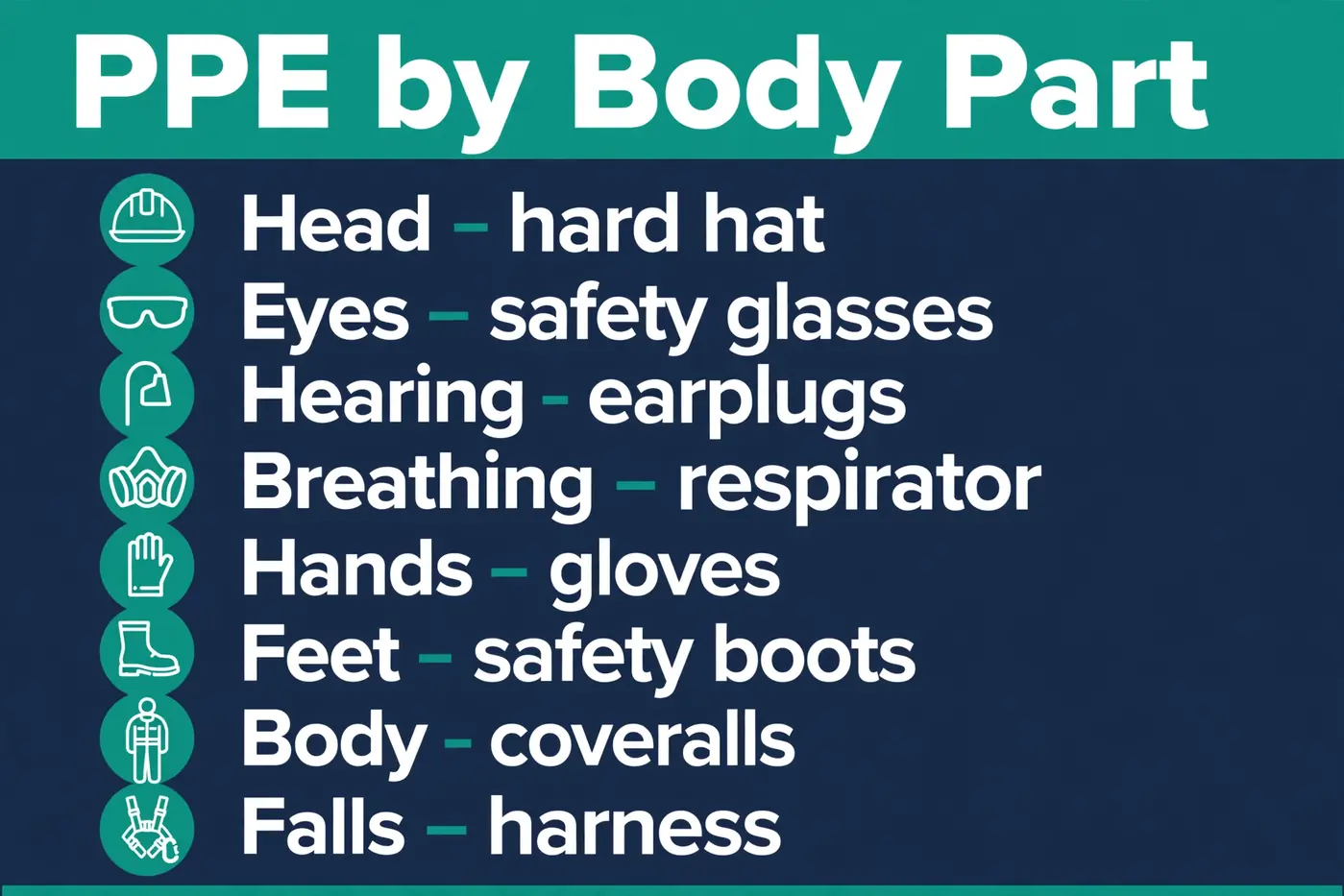
Different jobs need different PPE, because different body parts face different hazards:
| Body part / risk | Common PPE |
|---|---|
| Head — falling objects | Hard hat, safety helmet |
| Eyes and face — flying sparks, splashes | Safety glasses, goggles, face shield |
| Hearing — loud noise | Earplugs, earmuffs |
| Breathing — dust, fumes, germs | Respirator, mask |
| Hands — cuts, chemicals, heat | Safety gloves |
| Feet — falling objects, sharp items | Safety boots and shoes |
| Whole body — chemicals, infection | Coveralls, gown, full body suit |
| Falls from height | Harness and lanyard |
One worker may need several types at once. A nurse may wear gloves, a gown, a mask and eye protection together. A construction worker may wear a hard hat, safety glasses, gloves and safety boots together.
History / Origin
PPE did not start as one invention. Each item has its own story, and the hard hat shows the pattern best.
Before modern safety rules, workers had little head protection. During World War I, soldiers wore steel helmets, and one young officer saw how well they worked. After the war, Edward W. Bullard turned that idea into a hat for civilian workers. In 1919 he patented the “Hard-Boiled Hat”, made of steamed canvas, glue and black paint. It was the first commercially available head protection device.
Use spread slowly at first — mines, shipyards and lumber work — then faster on big projects. Hard hats were required on the Golden Gate Bridge construction in the 1930s, where falling rivets were a daily danger. Over time, materials changed too: canvas gave way to aluminium, then to fibreglass and thermoplastics, which are still the usual materials today.
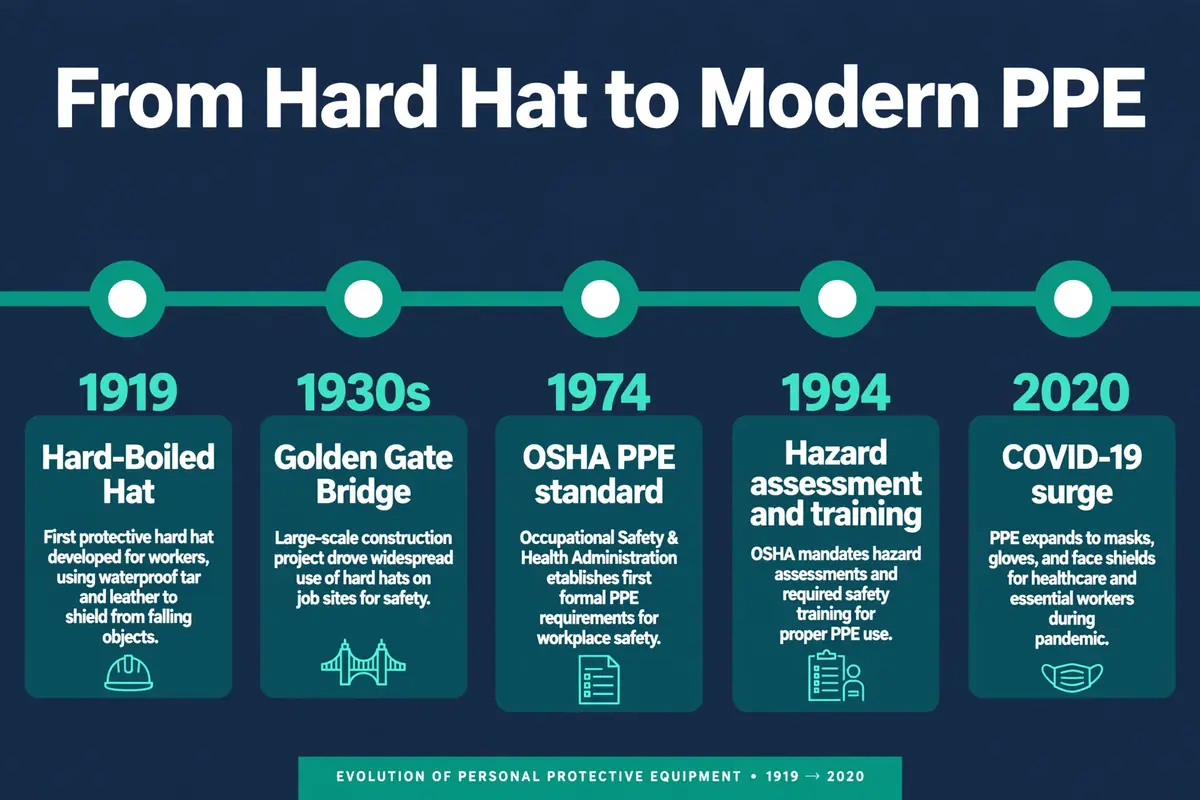
The rules caught up later. OSHA’s general-industry PPE standard, 29 CFR 1910.132, was first issued in 1974. A 1994 update made the employer’s job clearer: assess the workplace for hazards, choose the right PPE for each hazard, certify that assessment in writing, and train workers in how to use the PPE.
How PPE Has Changed Over Time
PPE changed in two ways: what it is made of, and who wears it.
Materials improved, so PPE became lighter and stronger — the canvas hard hat became a thermoplastic helmet, and simple cloth masks became fitted respirators. Rules also tightened, so employers, not just workers, became responsible for providing PPE, checking its fit, and training workers to use it.
Then, in 2020, COVID-19 changed who thought about PPE. Before the pandemic, PPE was mostly a workplace word. During the pandemic, masks, gloves and gowns became everyday items, and demand surged so fast that health workers faced severe shortages. PPE did not change its meaning in 2020, but it changed its place in daily life — from a site rule to a household word.
Not To Be Confused With
PPE is not the same as ordinary work clothes. A long-sleeve shirt, a pair of street shoes or a rain jacket may be useful, but they are not PPE unless they are made and chosen to protect against a specific hazard. Likewise, a face covering worn only for warmth is not PPE. What makes an item PPE is its job: it is selected for a hazard, it fits the wearer, and it is maintained so it still works.
Myth vs Fact
| Myth | Fact |
|---|---|
| PPE removes the hazard. | No. PPE only reduces the wearer’s exposure to it. Removing the hazard is better when it is possible. |
| Any gloves or glasses count as PPE. | No. PPE must fit the hazard — chemical gloves for chemicals, safety glasses for impact, and so on. The wrong type may not protect you. |
| PPE is only for hospitals. | No. It is used in construction, factories, labs, farms and hospitals — anywhere a hazard remains after other controls. |
| Once you have PPE, you need no training. | No. OSHA requires training in when PPE is needed, how to wear it, and how to care for it. |
Used in a Sentence
- “Wear your PPE before you enter the workshop — hard hat, glasses and gloves.”
- “The nurse put on PPE — a gown, gloves, mask and eye protection — before seeing the patient.”
- “The site manager checked that everyone’s PPE fitted properly.”
FAQs
What does PPE stand for?
PPE stands for Personal Protective Equipment — equipment worn to minimize exposure to workplace hazards.
Is a cloth face mask PPE?
It depends on why it is worn and how it is made. A respirator or a medical mask chosen to protect against a hazard can be PPE. A plain cloth covering worn only for warmth is not.
Who pays for PPE at work?
In general, under OSHA rules the employer must provide required PPE at no cost to the worker, with some exceptions for non-specialty items such as ordinary safety-toe shoes or everyday clothing. The exact exceptions depend on the rule, so this post does not list them all.
Does PPE replace safety rules?
No. PPE is the last step, not the first. Remove the hazard or control it first, then use PPE for what is left.
Conclusion
PPE stands for Personal Protective Equipment: the gear that protects one worker from one hazard at a time. It started with simple items like the 1919 hard hat, grew into a full set of rules in 1974 and 1994, and became a household word in 2020. Remember its limit and its strength: it does not make a job safe by itself, but worn correctly, for the right hazard, it is the barrier that stands between a worker and harm.

Founder & Editor, Linktova. Arshad Ullah is the Founder & Editor at Linktova. He has previously worked on vocabulary websites and now leads the Linktova Team in explaining what abbreviations stand for — their full forms, meanings, and everyday use — in simple language.