What does JDM stand for? JDM stands for Japanese Domestic Market.
In simple words, JDM means cars, parts, and options that Japanese makers built for sale in Japan, for buyers in Japan. It is not a car brand. Instead, it is a market label. In other words, it tells you the market makers built a car for and the rules they followed.
Quick Reference
| Item | Detail |
|---|---|
| Short form | JDM |
| Full form | Japanese Domestic Market |
| Read as | Initialism — “jay-dee-em” |
| Main use | Cars and parts made for the Japanese market |
| Key test | Sold new in Japan, under Japanese rules |
| Not JDM | A Japanese-brand car built for export |
Pronunciation
Say JDM letter by letter: “jay-dee-em”. Do not say it as one word.
Acronym or Initialism?
JDM is an initialism. You read its letters one by one. People often use the word “acronym” loosely for any short form like JDM. That use is common, but it is not exact.
What Is JDM?
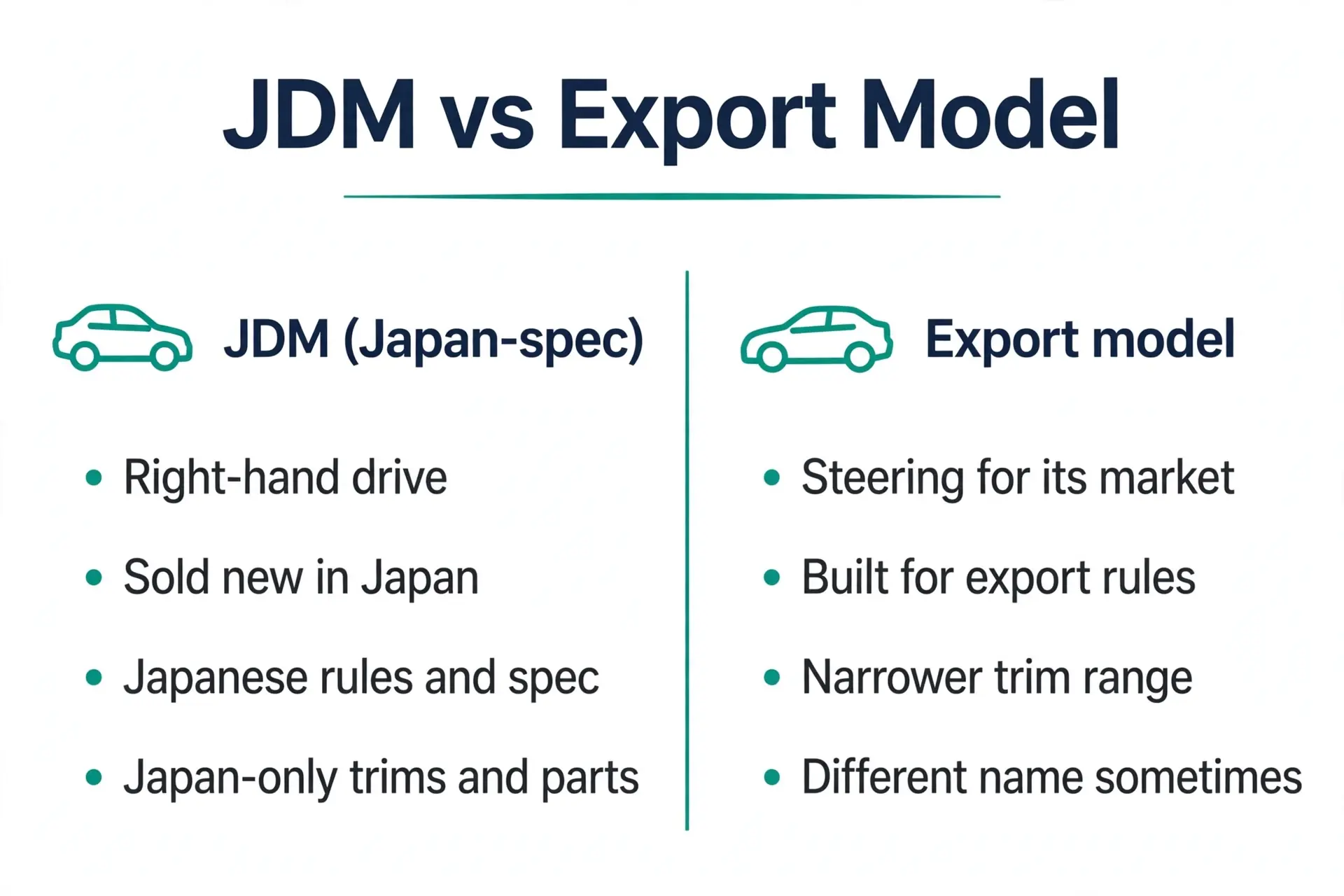
A JDM car is a car that makers built to Japan’s rules and dealers sold new to a buyer in Japan. The same model may look similar in another country. But the Japan-spec version can differ in engine, trim, lights, seats, and options.
JDM is about the market, not just the factory. For example, a Toyota built in Japan for the United States is not JDM. Makers built it for US rules. In contrast, a car sold new in Japan, under Japanese rules, is JDM — even if some of its parts came from outside Japan.
What JDM Actually Does
JDM does not do a job like a machine. Instead, it works as a specification. It sets the standard a car must meet before makers can sell it in Japan.
That standard shapes the car in real ways. For instance, it can set the steering side, the safety and emissions rules, and the size and engine class. It can also shape the options list. In fact, makers offered some trims, engines, and parts only in Japan. That is why collectors look for Japan-spec cars and parts.
Where Is JDM Used?
You will see JDM in car culture, sales, and imports: Car meets and shows, where Japan-spec cars sit side by side with export cars. Used-car imports, where buyers look for models that dealers never sold in their own country. Tuning and parts, where owners fit Japan-only parts, wheels, and kits to a car. Online listings, where “JDM” tells a buyer that a car or part follows Japanese spec.
Famous JDM-era models include the Nissan Skyline GT-R, the Toyota Supra, the Mazda RX-7, and the Mitsubishi Lancer Evolution. These names matter because they show the range of Japan’s golden age of sports cars. Makers built each one for the Japanese market first, and then it won fans abroad.
JDM vs Export Models
The clearest difference is the steering wheel. Japan drives on the left side of the road, so JDM cars are right-hand drive. Export cars use the steering side of their own market.
Other differences can be smaller, but they still matter to buyers. For example, a JDM car may have Japanese-language labels, a different radio band, or features tuned for Japan’s roads and fuel.
A simple test helps. If dealers first sold a car in Japan, under Japanese type approval, and in Japanese spec, it is JDM. If makers built it for another market, it is not JDM — even if the brand is Japanese.
Where Did JDM Come From?
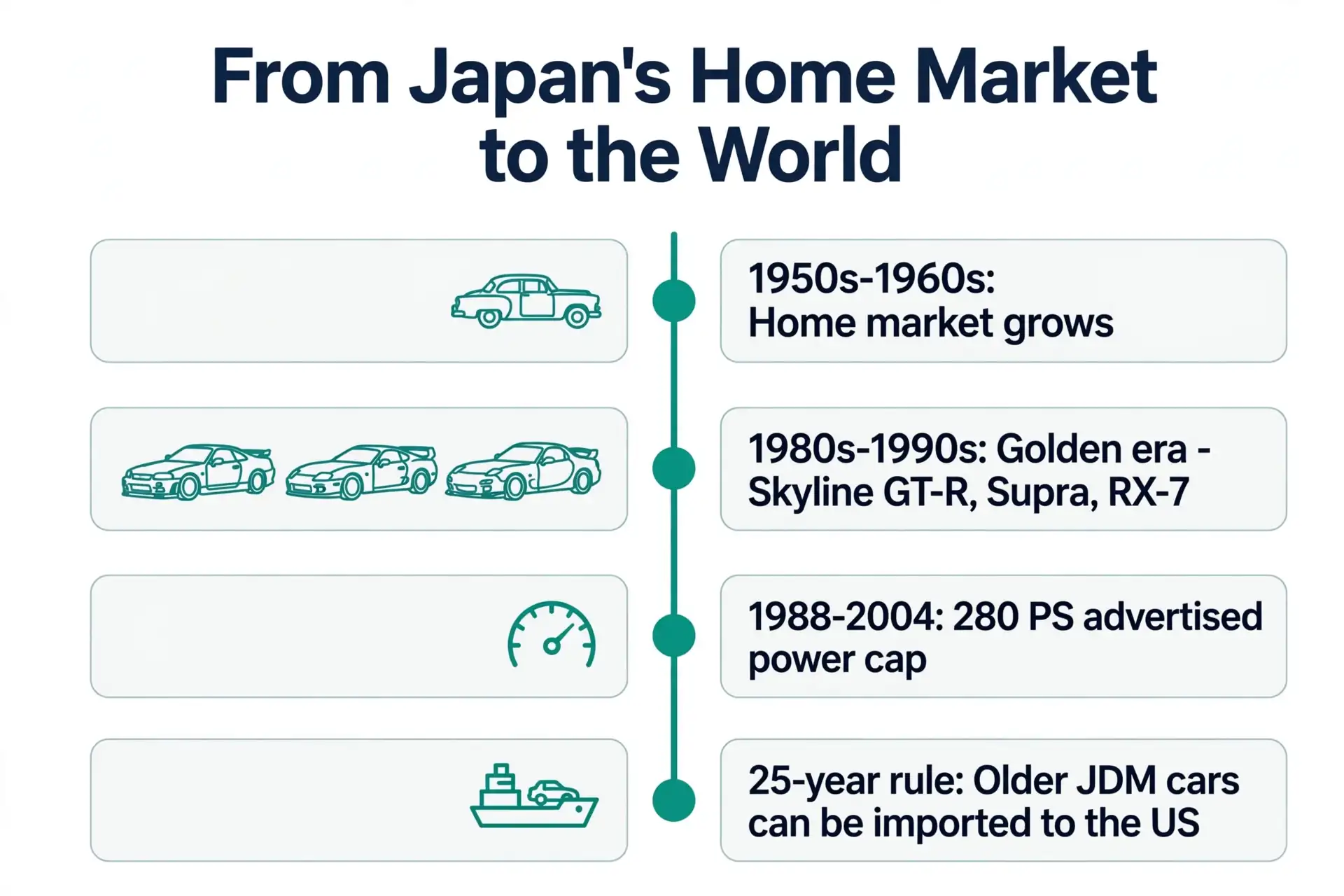
Japan’s car industry grew fast after World War II. In the 1950s and 1960s, makers such as Toyota, Nissan, Honda, and Mazda built cars for a growing home market. Japan’s roads were narrow, fuel was costly, and space was tight. So makers focused on compact, efficient cars that fit Japanese life.
By the 1980s and 1990s, Japan entered a golden era for performance cars. This period gave the world the Skyline GT-R, the Supra, the RX-7, and the Lancer Evolution. Fans outside Japan began to notice that Japan’s home cars were often different — and sometimes more exciting — than the export versions.
How JDM Has Changed Over Time
One famous change was the “gentlemen’s agreement”. From 1988, Japanese makers agreed to limit the advertised power of home-market cars to 280 PS. The limit stayed in place until 2004, when the Honda Legend was rated at 300 PS. In practice, some famous engines made more power than the official figure. But the official cap shaped how makers talked about power for years.
Another change is legal, not technical. In the United States, buyers can import a car under the 25-year rule once it reaches 25 years of age. As a result, many JDM classics reached American buyers.
Today, JDM still means Japan-spec. However, car culture also uses the word loosely for any Japanese performance car. That wider use is common, but the strict meaning has not changed: a car sold new for Japan.
What JDM Has Achieved
JDM’s impact is cultural and practical, not a single sales figure. It turned Japan-spec cars into collector cars around the world. It created a global market for used Japanese cars and parts. And it gave fans a clear way to talk about spec: a JDM car is not just “Japanese”, it is Japan-spec.
Its influence also shows in tuning culture. Japan-only trims, parts, and tuning houses such as Nismo, Mugen, and TRD became names that fans chase. A car with those parts tells a story about where it came from and which market makers built it for.
What JDM Cannot Do
JDM alone does not mean a car is better, faster, or legal in your country. For instance, a Japan-spec car may need changes to meet local safety, emissions, or lighting rules. Right-hand drive may also feel hard to use in a left-hand-drive country. And a car labelled “JDM” in an ad may only have JDM-style parts, not a true Japan-spec history. Always check the car’s first market, not just its badge.
Not To Be Confused With
Japanese-made: A car built in Japan. It is not JDM unless dealers also sold it for the Japanese market. USDM / EUDM: US Domestic Market and European Domestic Market. These are the same idea, for the United States and Europe. JDM-style: A build that looks Japanese, with Japanese parts or styling. It may not be a true JDM car.
Myth vs Fact
| Myth | Fact |
|---|---|
| Myth: Every Toyota, Honda, or Nissan is JDM. | Fact: Only the ones sold for the Japanese market are JDM. Export models are not. |
| Myth: JDM means a car was built in Japan. | Fact: JDM means it was built for Japan. The factory location alone is not enough. |
| Myth: A JDM car is always more powerful. | Fact: For years, home-market cars had an advertised power cap. Some were strong, but power alone does not define JDM. |
Used in a Sentence
- That Skyline is a true JDM car — dealers sold it new in Japan.
- This part is JDM-only, so makers never offered it on the export model.
- He drives a Japanese car, but it is not JDM because makers built it for the US market.
FAQs
What does JDM stand for?
JDM stands for Japanese Domestic Market. It means cars and parts that makers built for sale in Japan.
Is every Japanese car JDM?
No. In short, a car is JDM only if dealers sold it new in Japan, under Japanese rules. A Japanese-brand car built for export is not JDM.
Why do people want JDM cars?
Many fans want Japan-only models, trims, and parts that dealers never sold in their own country. Some also value the history and spec of a true Japan-spec car.
Can I import a JDM car?
It depends on your country’s rules. For example, in the United States, the 25-year rule is the main route for older cars. Always check local import, safety, and emissions rules first.
Conclusion: What Does JDM Stand For?
JDM stands for Japanese Domestic Market. It is a market label, not a brand. It means makers built a car or part for buyers in Japan, under Japanese rules. In the end, that simple test — sold new in Japan, in Japanese spec — is the best way to tell a true JDM car from a Japanese car that makers simply built for export.

Founder & Editor, Linktova. Arshad Ullah is the Founder & Editor at Linktova. He has previously worked on vocabulary websites and now leads the Linktova Team in explaining what abbreviations stand for — their full forms, meanings, and everyday use — in simple language.