OSHA stands for Occupational Safety and Health Administration.
OSHA is a U.S. federal agency. It works to keep workplaces safe and healthy for workers.
Quick Reference
| Item | Detail |
|---|---|
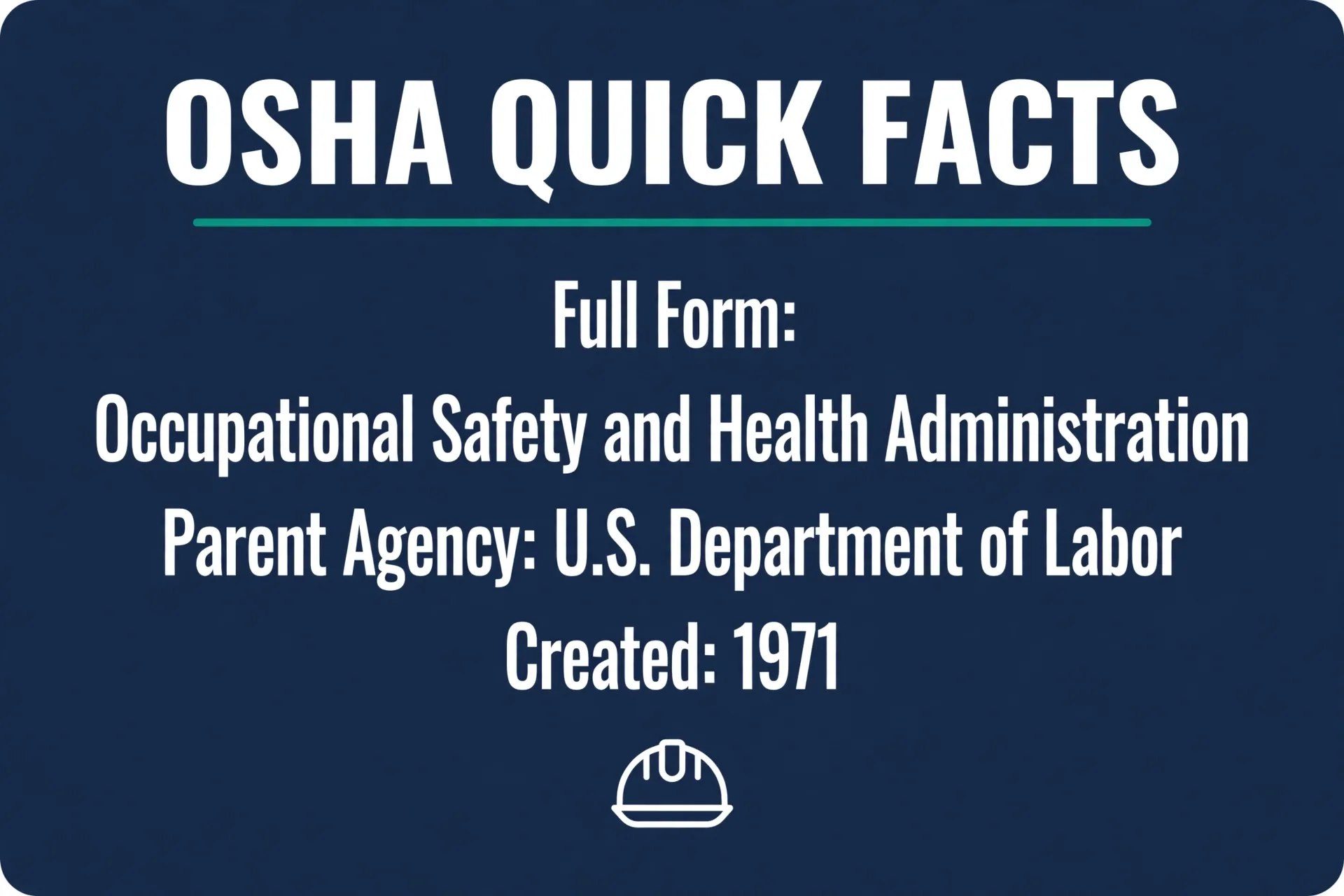
| Full form | Occupational Safety and Health Administration |
| Short form | OSHA |
| Category | Government & Public Services |
| Parent organisation | United States Department of Labor |
| Created | April 28, 1971, under the Occupational Safety and Health Act of 1970 |
| Pronunciation | OH-shuh (said as one word, not letter by letter) |
| Current status | Active U.S. federal agency |
| Headquarters / Main office | Washington, DC, USA |
Pronunciation
OSHA is pronounced “oh-sha” — as one word.
Acronym or Initialism?
In strict terms, OSHA is an acronym, not an initialism. An acronym is read as a word — OSHA is read as “oh-sha”. An initialism is read letter by letter, for example D-M-V. Many people use “acronym” loosely for both kinds, but OSHA fits the strict acronym pattern because it is spoken as one word.
OSHA’s Offices
OSHA works through a national office in Washington, DC, plus regional offices and more than 85 area offices across the United States. Regional offices cover groups of states, and area offices are the local points of contact where inspections and worker complaints are handled. In states with their own approved State Plan, that state program handles much of the day-to-day work, under OSHA’s oversight.
What Does OSHA Stand For?
OSHA stands for Occupational Safety and Health Administration. Each word tells you its job. “Occupational” means related to work. “Safety and Health” means protection from harm and illness. “Administration” means it is a government agency that runs this work.
Where Did OSHA Come From?
Before OSHA, there was no single national safety rule for American workplaces. Safety rules were a patchwork of state and local rules, so protection depended a lot on where a worker lived. In the 1960s, injuries rose again as industry grew, and about 14,000 workers were dying on the job each year.
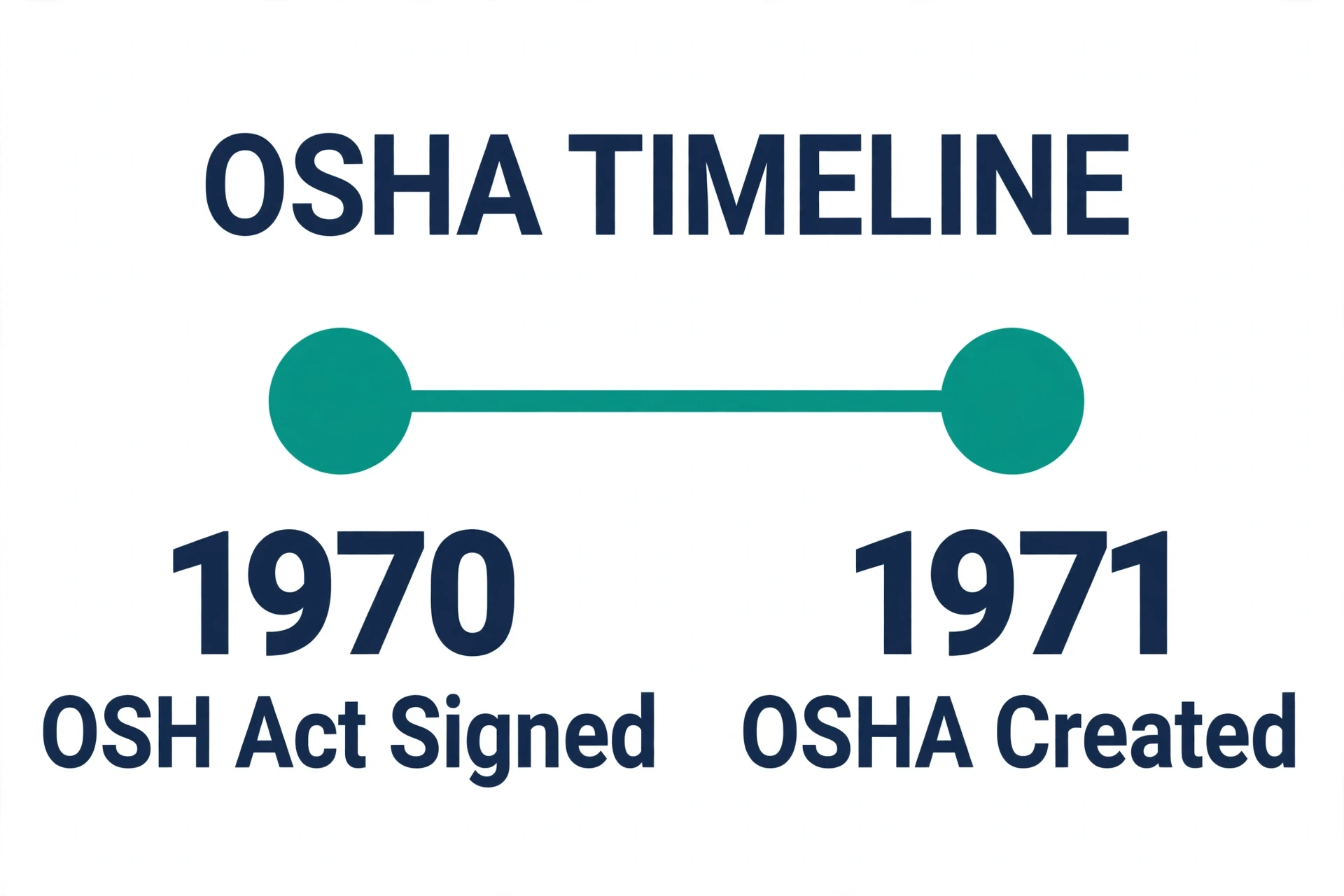
Congress answered with one federal law: the Occupational Safety and Health Act, signed on December 29, 1970. OSHA itself opened on April 28, 1971, inside the U.S. Department of Labor. Its job was new in an important way: instead of only paying workers after an injury, it had to prevent injuries by setting safety standards and checking workplaces.
OSHA changed over time, too. In its first decade it issued its first standards — for asbestos in 1972, then for other hazards such as vinyl chloride and cotton dust — and it added help beside enforcement: state plans run by states, a free On-Site Consultation Program for small businesses in 1975, and training for inspectors and workers. That is why today’s OSHA is not only an inspector: it sets rules, checks workplaces, and also trains and advises.
What Is OSHA?
OSHA is part of the United States Department of Labor. It sets safety rules for workplaces. It also checks workplaces, and it gives training and help to workers and employers.
Its mission is simple. It wants safe and healthy working conditions for working people. It does this by setting standards, by enforcing those standards, and by providing training, outreach, education, and assistance.
A short timeline shows how it started:
- See “Where Did OSHA Come From?” above for the full origin story.
Where Is OSHA Used?
You will see OSHA most often in four areas. These are its main standard groups:
| Area | Where you see it |
|---|---|
| General Industry | Factories, warehouses, offices, and most private workplaces |
| Construction | Building sites, scaffolding, and fall protection |
| Agriculture | Farm work and field safety |
| Maritime | Ports, ships, and dock work |
Some states run their own safety programs. These are called state plans. A state plan must be at least as strong as the federal OSHA program. It can also be stronger.
Acronym, Initialism, or Backronym?
OSHA is a true acronym. You say it as one word: OH-shuh. You do not spell it out letter by letter as O-S-H-A in normal speech.
This is different from an initialism. An initialism is said letter by letter. For example, FBI is said as F-B-I, not as one word. OSHA is like NASA in this way. Both are spoken as words.
Myth vs Fact
Myth: OSHA is only for construction workers.
Fact: OSHA covers general industry, agriculture, construction, and maritime work. Construction is only one part of its work.
Myth: OSHA only fines employers.
Fact: OSHA also gives help. Its On-Site Consultation Program is free and confidential for small and medium businesses. It is separate from enforcement, and it does not issue citations or penalties for issues found during a consultation visit.
Myth: OSHA covers every worker in the United States.
Fact: OSHA generally does not cover self-employed workers. Some public-sector workers are covered through state plans, not through federal OSHA directly. Always check the current rule for your state and job type.
Used in a Sentence
- “Our factory follows OSHA rules for machine safety.”
- “The manager asked OSHA for help to check our warehouse for hazards.”
- “After the training, every worker knew how to report an OSHA safety concern.”
OSHA vs NIOSH — Do Not Confuse Them
| Term | What it does |
|---|---|
| OSHA | Sets and enforces workplace safety rules |
| NIOSH | Researches workplace safety and health, and gives recommendations |
NIOSH stands for the National Institute for Occupational Safety and Health. It studies risks and suggests safer ways to work. OSHA is the agency that sets and enforces the rules. They work in the same field, but they do not do the same job.
FAQ
Is OSHA a government agency?
Yes, and this is why its rules carry legal weight. OSHA is a federal agency inside the United States Department of Labor. That is different from a private safety company, which can advise you but cannot set federal law.
Does OSHA apply to small businesses?
Yes, in most cases. OSHA standards cover nearly every private-sector employer. Size alone does not remove the duty to keep a workplace free from known dangers. The free consultation program exists in part because small businesses often need help to meet the same standards.
What do OSHA 10 and OSHA 30 mean?
They are training courses, not laws. OSHA 10 is a basic 10-hour awareness course. OSHA 30 is a longer, more detailed 30-hour course. Both are offered through OSHA-authorized training providers. They teach workers how to spot and avoid common hazards.
Is OSHA only in the United States?
Yes, for the federal agency itself. OSHA is a U.S. agency. Other countries have their own safety bodies. For example, the United Kingdom has the Health and Safety Executive (HSE). The full form is the same idea, but the agency is different.
Conclusion
OSHA stands for Occupational Safety and Health Administration. It is a U.S. federal agency that sets and enforces workplace safety rules, and helps workers and employers stay safe. If you work in the United States, OSHA is the name behind the safety rules in your workplace.

Founder & Editor, Linktova. Arshad Ullah is the Founder & Editor at Linktova. He has previously worked on vocabulary websites and now leads the Linktova Team in explaining what abbreviations stand for — their full forms, meanings, and everyday use — in simple language.
Pingback: DMV Stands For – Full Form, Meaning and Examples | Linktova
Pingback: DC Stands For – Full Form, Meaning and Examples | Linktova
Pingback: PPE Stands For – Full Form, Meaning and Examples | Linktova