
What does DC stand for? The short answer is District of Columbia.
That is the most common answer, but it is not the only one. The meaning of DC changes with the place where you see it. For example, in an address, it is the US capital district. In a comic shop, it is a publisher. Meanwhile, in an electronics manual, it is a type of electric current. This post starts with all three, then explains each one in turn.
| Short form | DC |
| Most common full form | District of Columbia |
| Type | Initialism — say the letters: “dee-see” |
| Capital city | Washington, in the District of Columbia |
| Other common meanings | Detective Comics; direct current |
Note: If you saw DC at a motor-vehicle office, that is DC DMV — see the DMV post at https://linktova.com/what-does-dmv-stand-for/ for that meaning. This post covers the capital district, the comics publisher and the electric current.
Pronunciation
People pronounce DC “dee-see” — say the letters one by one, not as one word.
Acronym or Initialism?
In strict terms, DC is an initialism, not an acronym. People read an acronym as a word — for example, they read NASA as “nasa”. People read an initialism letter by letter — they read DC as “dee-see”, not as one word. Many people use the word “acronym” loosely for both kinds, so you may still hear people call DC an acronym. But if you want the exact term, DC is an initialism, because you say its letters one by one.
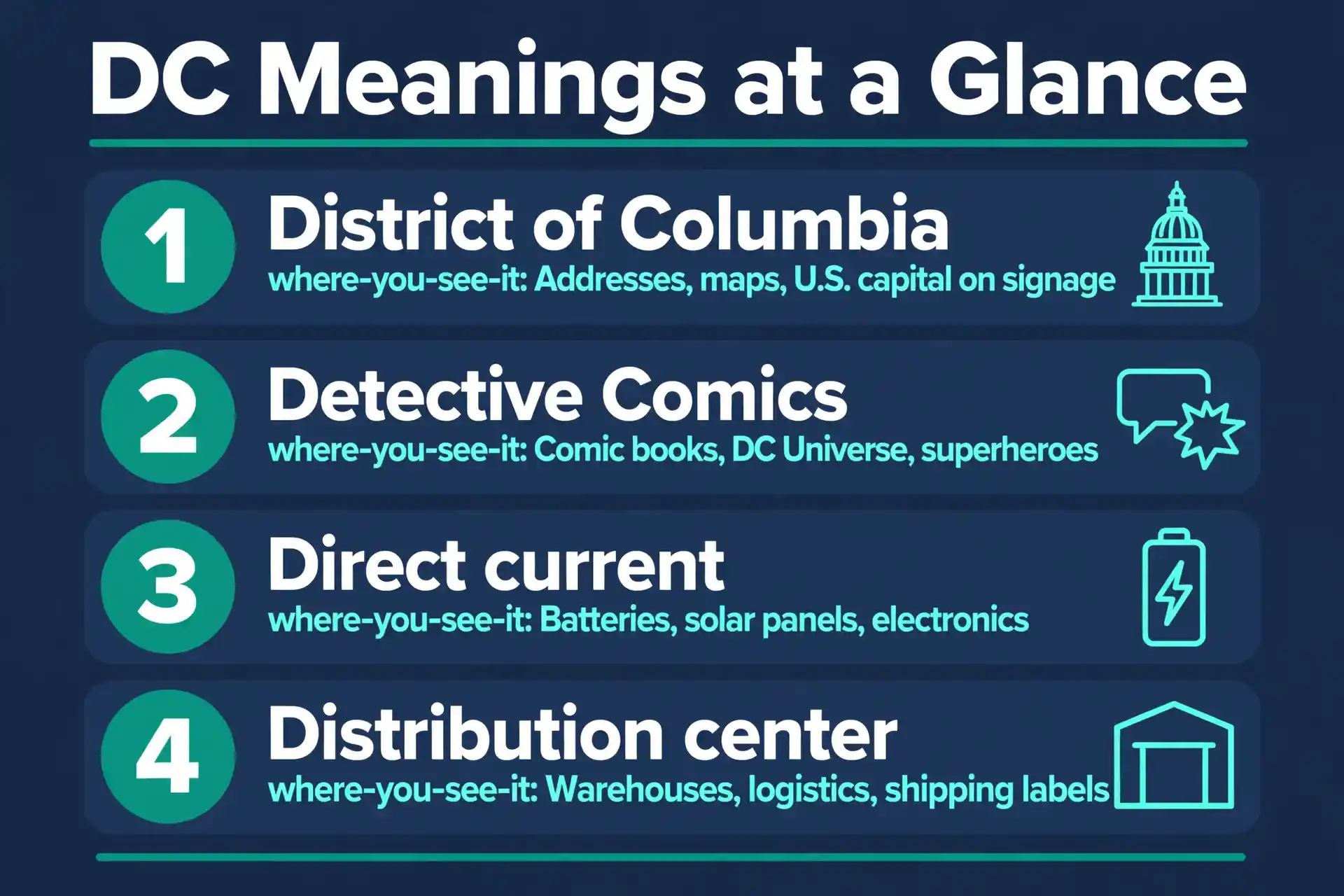
DC Meanings at a Glance
| 1 | District of Columbia | Addresses, news, politics, maps |
| 2 | Detective Comics (DC Comics) | Comics, films, games |
| 3 | Direct current | Batteries, chargers, electronics |
| 4 | Distribution center | Warehouses, delivery, shopping |
What Is the District of Columbia?
The District of Columbia is a federal district, not a state. Congress created it so the national government would not sit inside any one state. The city of Washington grew inside it, which is why people say “Washington, D.C.”
History / Origin
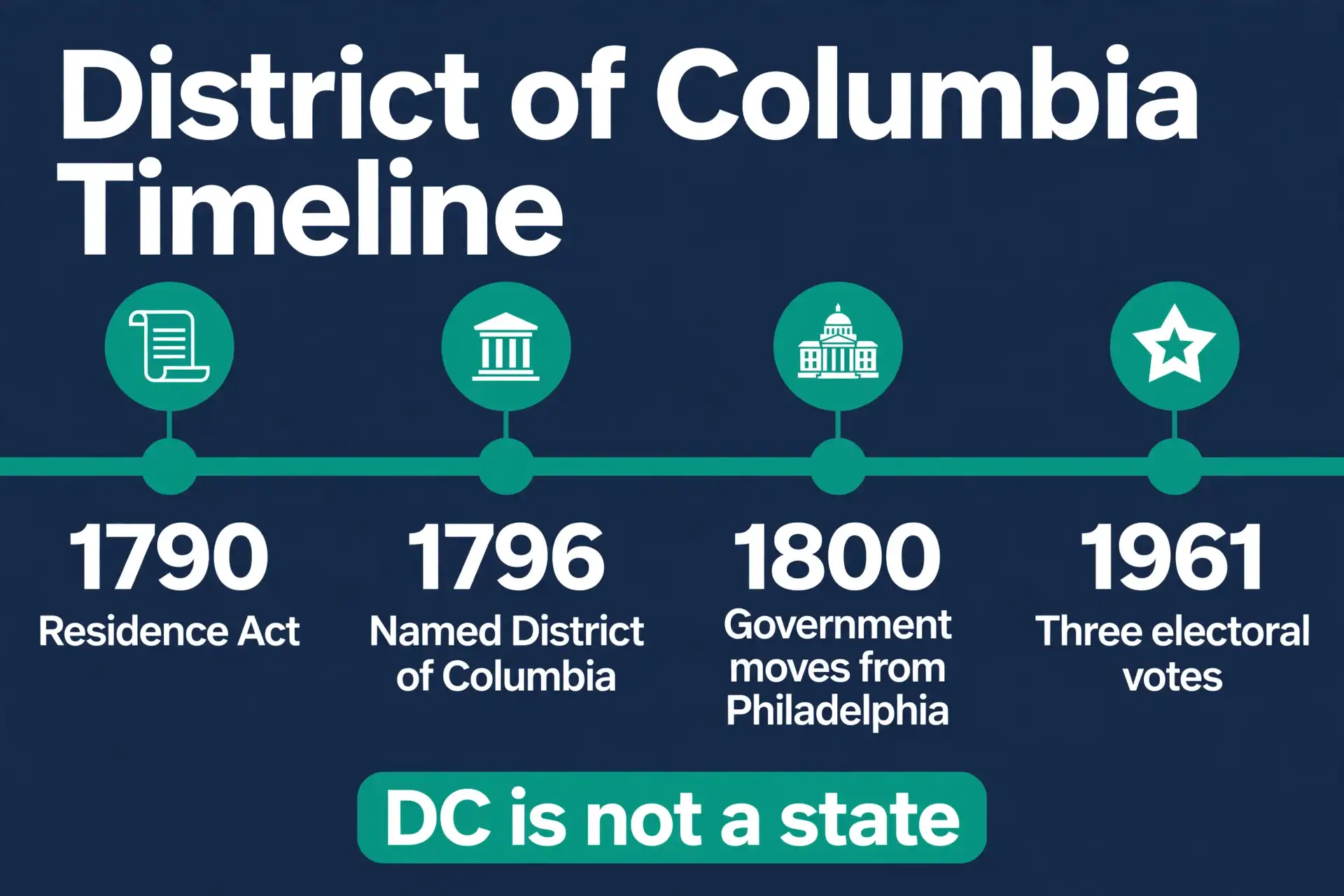
- 1790 Congress passes the Residence Act and creates a federal district along the Potomac River, on land given by Maryland and Virginia.
- 1796 The district officially takes the name District of Columbia.
- 1800 The federal government moves there from Philadelphia.
- Later Virginia takes back the land south of the Potomac that it had given, so the District becomes smaller.
- 1961 The Twenty-Third Amendment gives DC three electoral votes for president and vice president.
“Columbia” was a popular name for the United States at the time, taken from Christopher Columbus. “Washington” honours George Washington, the first president. So the full name joins a city named for Washington with a district named Columbia.
Current Status: Not a State
This point still confuses many readers, so it is worth stating plainly. DC residents can vote for president, thanks to those three electoral votes. However, DC has no voting senators and no voting member of the House of Representatives. In addition, it has a delegate in the House who cannot vote on the House floor. That is why you will hear debates about DC statehood: statehood would change this status, but it has not happened.
Main Offices of the District of Columbia Government
Three main parts run DC, not one office alone:
Office of the Mayor (Executive) — The Mayor heads the executive branch and oversees the District’s departments and city services, including police and fire protection, public schools and public property.
Council of the District of Columbia (Legislative) — The Council is the legislative branch. It has thirteen members: one elected from each of the city’s eight wards, plus four at-large members and a chair elected at large.
DC Courts (Judicial) — The District of Columbia Court of Appeals is the highest court, and it began in 1970. The Superior Court is the local trial court, hearing criminal and civil cases.
Note: this is only the main structure. The District government has many departments and agencies under these branches, and listing all of them here would turn this post into a directory, not a “what does DC stand for” answer. DC Comics’ imprints and direct current have no such government offices, so no sub-offices section is added for those meanings.
DC Comics: Detective Comics
In comics, DC stands for Detective Comics. In fact, it is the name of the publisher behind Superman, Batman and Wonder Woman. The company traces to National Allied Publications, founded in 1934. Then its title Detective Comics appeared in March 1937. Two years later, in May 1939, Detective Comics #27 introduced Batman. Superman had already appeared in Action Comics #1 in 1938. Over time, the short name DC stuck, and the company became known as DC Comics. A recent example shows the name is still active: the new DC Universe film run opened with 2025’s ‘Superman’, just as the earlier DC Extended Universe had opened with a Superman film. The characters are the same family, even when the films start again. Do not mix this DC with the capital district. The publisher does not take its name from Washington, D.C. Instead, it takes its name from its own comic title.
Direct Current: Electricity That Flows One Way
In electronics, DC stands for direct current. It is electric current that flows in one direction only, at a steady value. In fact, you meet DC every day, even if you never read the letters:
- A battery gives DC power to a phone, a remote or a torch.
- A charger changes the AC power from a wall outlet into DC for your device.
- A solar panel also produces DC power.
DC vs AC: Not to Be Confused With
AC stands for alternating current. Its flow switches direction again and again. That is the power in a wall outlet in the US. In contrast, DC does not switch. That one difference is the whole point: if a device says “DC input”, it needs steady, one-way current, not wall-outlet AC straight from the socket.
How DC Has Changed Over Time
District of Columbia — the district became smaller after Virginia took back the land it had given south of the Potomac, and its voting position changed in 1961 with three electoral votes — but it is still not a state, and statehood has not happened.
DC Comics — the company traces to National Allied Publications (1934), its Detective Comics title appeared in 1937, and it became known as DC Comics; its film runs have since restarted, most recently with 2025’s “Superman”.
Direct current — no change-over-time element appears here. Its definition in this draft — current flowing in one direction only, at a steady value — still restates the point from the section above.
Myth vs Fact
| DC stands for “District of Congress” | No. It stands for District of Columbia. |
| DC stands for “District of Capital” | No. “Capital” is not part of the name. |
| Washington, D.C. and Washington state are the same place | No. Washington state is in the Pacific Northwest. Washington, D.C. is the federal district on the East Coast. |
| DC Comics is named after the capital | No. Its DC comes from Detective Comics. |
Used in a Sentence
“She lives in Washington, D.C., near the National Mall.”
“The new Batman story is a DC Comics title.”
“This charger takes AC from the wall and gives DC to the phone.”
FAQs
Q: Is DC a state?
A: No. DC is a federal district. It has three electoral votes for president, but no voting representation in Congress.
Q: Why do some people write D.C. with periods?
A: Both DC and D.C. are used for the same district. The periods are a style choice. People still speak the letters one by one.
Q: What does DC mean on a delivery parcel?
A: In that context it most often means a distribution center — the warehouse that holds goods before delivery. Check the sender’s tracking page if the parcel context is unclear, because this meaning is different from the capital, the publisher and the electric current.
Q: Does DC always mean the same thing?
A: No. Always read the sentence around it. For instance, politics points to the District of Columbia, comics point to Detective Comics, and a battery or charger points to direct current.
Conclusion: What Does DC Stand For?
DC stands for District of Columbia first, but the letters earn their other meanings honestly: Detective Comics gave the publisher its name, and direct current describes how a battery’s power flows. So what does DC stand for? In short, when you are not sure, ask one question: is this about a place, a comic, or a current? That question almost always gives you the right answer.
See also: OSHA Stands For – Full Form, Meaning and Examples and DMV Stands For – Full Form, Meaning and Examples

Founder & Editor, Linktova. Arshad Ullah is the Founder & Editor at Linktova. He has previously worked on vocabulary websites and now leads the Linktova Team in explaining what abbreviations stand for — their full forms, meanings, and everyday use — in simple language.