ESP can mean three different things. The table below ranks them by how often each meaning appears when people search this exact question. You may have asked what does ESP stand for — here is the short answer.
| Rank | Meaning | Full form | Where you meet it |
|---|---|---|---|
| 1 | Car safety system | Electronic Stability Programme | On a car dashboard or in a car manual |
| 2 | The “sixth sense” | Extrasensory Perception | In books, films, and talk about psychic powers |
| 3 | Language teaching | English for Specific Purposes | In English courses for work or study |
Quick Reference
| Field | Detail |
|---|---|
| Full form | Electronic Stability Programme (cars); Extrasensory Perception (the “sixth sense”); English for Specific Purposes (teaching) |
| Pronounced | “ee-ess-pee” |
| Type | Initialism — read letter by letter |
| Category | Everyday Acronyms |
Pronunciation
ESP is pronounced “ee-ess-pee”, letter by letter.
Acronym or Initialism?
ESP is an initialism. You read it letter by letter, as “ee-ess-pee”, not as one word.
People often use the word “acronym” loosely for both kinds. That is fine in everyday talk. But strictly, ESP is an initialism.
What Does ESP Stand For?
What does ESP stand for? It depends on where you see it. In a car, ESP stands for Electronic Stability Programme. It is a safety system that keeps your car stable.
In talk about psychic powers, ESP stands for Extrasensory Perception. It means sensing things without using your normal senses.
In language teaching, ESP stands for English for Specific Purposes. It means English lessons built for one job or subject.
The car meaning comes first in this article. It is the meaning most search results show for this exact question.
ESP in Cars: Electronic Stability Programme
What Is It?
If you ask what ESP stands for on a car, the answer is Electronic Stability Programme. This is a car safety system. It helps you keep control when your car starts to skid.
ESP also works with your anti-lock brakes (ABS). It is one of the most important safety systems in a modern car.
ESP is the same system as ESC, which stands for Electronic Stability Control. So car makers just use different names for it.
How ESP Works
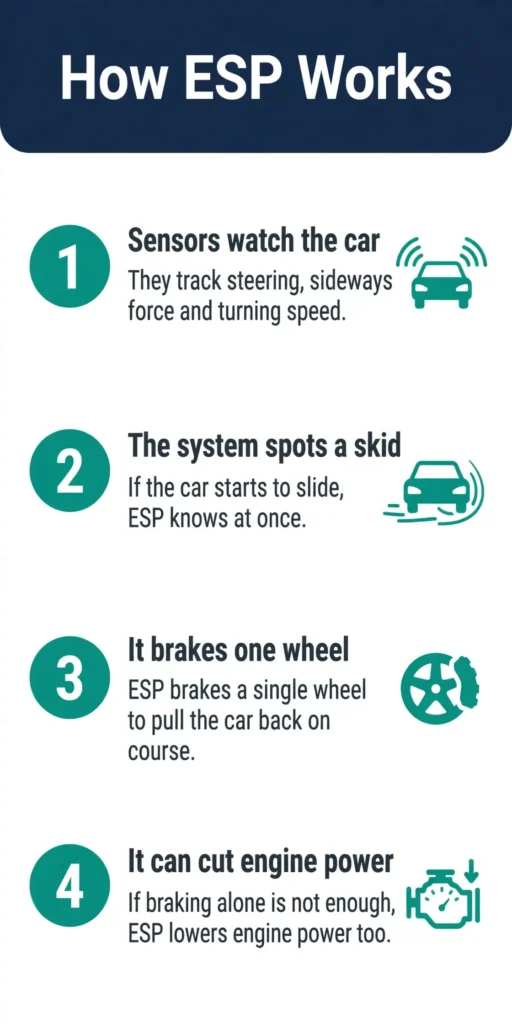
ESP watches how your car moves. It then compares what you want the car to do with what the car is really doing.
- Sensors watch the car. They track the steering angle, the sideways force, and how fast the car turns.
- The system spots a skid. If the car starts to slide, ESP knows at once.
- It brakes one wheel. ESP brakes a single wheel to pull the car back on course.
- It can cut engine power. If braking alone is not enough, ESP lowers the engine power too.
All of this happens in a split second. As a result, you may feel the brake pedal pulse, and you may see the ESP light flash. That flash means the system is working.
What ESP Has Achieved
Bosch, the company that built the system, says ESP has saved about 15,000 lives in the European Union alone. It also says the system has helped avoid just under half a million accidents with injuries.
Bosch also says ESP can prevent up to 80 percent of skidding accidents. These are Bosch’s own figures, not independent counts.
Today, ESP is standard in most new cars. In fact, more than 250 million ESP systems have been built, according to Bosch.
Where Did ESP Come From?
ESP grew out of earlier safety systems, so the story starts in the 1980s.
From 1987 to 1992, Mercedes-Benz and Bosch worked together on a new system. They called it “Elektronisches Stabilitätsprogramm”, which is German for Electronic Stability Programme.
In May 1995, ESP had its first production premiere. It appeared in the Mercedes-Benz S 600 Coupé. The system came as standard on the most powerful V12 models first.
In 1997, a Mercedes A-class car rolled over during a swerving test in Sweden. The test was called the “elk test”. After that, Mercedes made ESP standard on its cars. Other car makers soon followed.
In 1999, Mercedes became the first brand to fit ESP as standard on all its passenger cars. In the European Union, ESP became compulsory for all new car types in November 2011. It became compulsory for every new car from November 2014.
ESP vs ESC
ESP and ESC are the same system. ESC stands for Electronic Stability Control. It is the name used most in North America.
Other makers use their own names for the same system. For example, BMW calls it DSC (Dynamic Stability Control). Toyota calls it VSC (Vehicle Stability Control). General Motors calls it StabiliTrak.
Do not confuse ESP with EPS. EPS stands for Electric Power Steering. It helps you steer the car. ESP, on the other hand, helps you keep the car stable.
The ESP Light
Your car has an ESP light on the dashboard. A light that flashes for a moment means the system is working to stop a skid.
However, a light that stays on can mean a fault, or that the system has been switched off. Check your car handbook if the light stays on.
ESP as Extrasensory Perception: The “Sixth Sense”
This is the meaning most people know from films and books. It is about sensing things without using your eyes, ears, or other normal senses.
ESP, in this sense, is said to cover three claimed powers:
- Telepathy. Reading another person’s thoughts, without words or signs.
- Clairvoyance. Seeing objects or events that are hidden from normal view.
- Precognition. Knowing about a future event before it happens.
Where Did This Meaning Come From?
The term was popularised in the 1930s by J. B. Rhine. He worked at Duke University in North Carolina, in the United States.
Rhine then ran lab tests with a pack of cards called Zener cards. The pack had 25 cards, with five symbols: a circle, a square, wavy lines, a cross, and a star.
A person had to guess each card without seeing it. By chance alone, they would get about 20 percent right. Rhine wrote up his work in a book called Extra-Sensory Perception in 1934.
What Does Science Say?
Science does not accept extrasensory perception as proven. In fact, there is no reliable evidence that it exists.
Also, Rhine’s results have never been duplicated by other scientists. Critics say his results can be explained by cheating or by small clues the subjects picked up.
Because of this, most scientists class extrasensory perception as a pseudoscience. That means it looks like science but lacks good proof.
So ESP, in this sense, is a popular idea, not a proven fact. The car system, by contrast, is real and tested.
ESP in English Teaching: English for Specific Purposes
This is a specialist meaning. It is an approach to teaching English for one clear purpose.
Instead of general English, learners study the English they need for their job or subject. A nurse studies medical English. A lawyer studies legal English.
The field grew from the early 1960s. It was formalised in a 1987 book by Tom Hutchinson and Alan Waters, called English for Specific Purposes: A Learning-Centred Approach.
Its main branches also include EAP (English for Academic Purposes), EOP (English for Occupational Purposes), EBP (English for Business Purposes), EMP (English for Medical Purposes), and ELP (English for Legal Purposes).
Other Meanings in One Line
ESP also means Stack Pointer in computing (a register in a processor) and Event Stream Processing in software (a way to spot patterns in streams of data). These are rare outside their own fields.
Not To Be Confused With
ESP and ESC are the same car system, not two systems. In other words, the name only changes by car maker.
ESP (car) and ESP (sixth sense) share the same letters but nothing else. So the context tells you which one is meant. A dashboard light means the car system. A film about mind reading means the sixth sense.
ESP is not EPS. ESP keeps your car stable. EPS helps you steer.
Key Terms
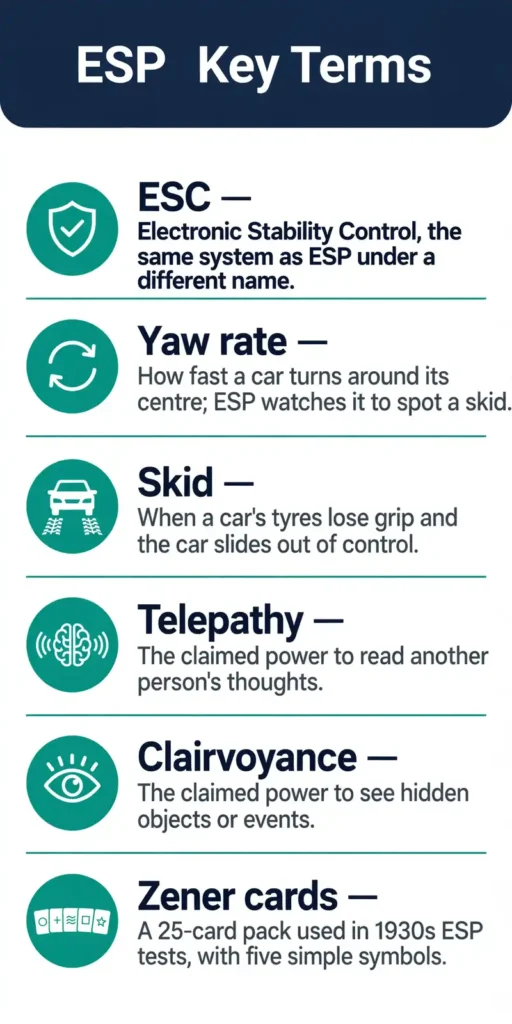
- ESC — Electronic Stability Control, the same system as ESP under a different name.
- Yaw rate — How fast a car turns around its centre; ESP watches it to spot a skid.
- Skid — When a car’s tyres lose grip and the car slides out of control.
- Telepathy — The claimed power to read another person’s thoughts.
- Clairvoyance — The claimed power to see hidden objects or events.
- Zener cards — A 25-card pack used in 1930s ESP tests, with five simple symbols.
FAQs
What does ESP stand for on a car?
ESP stands for Electronic Stability Programme. It is a safety system that stops your car from skidding. It brakes one wheel at a time and can cut engine power to keep the car stable.
Is ESP the same as ESC?
Yes. ESP and ESC are the same system. ESP is the name Bosch trademarked, and ESC (Electronic Stability Control) is the name used most in North America. BMW, Toyota, and General Motors use their own names too.
Is extrasensory perception real?
There is no reliable scientific evidence that it is real. For example, J. B. Rhine’s 1930s tests at Duke University were never duplicated. Most scientists class extrasensory perception as a pseudoscience.
What does ESP mean in English teaching?
ESP stands for English for Specific Purposes. It means English lessons built for one job or subject, such as medical English for nurses or legal English for lawyers.
See also
- What Does JDM Stand For? — another car acronym, for cars built for the Japanese market.
Conclusion
So, what does ESP stand for? It depends on where you see it. On a car, it is the Electronic Stability Programme, a proven safety system from 1995. In books and films, it is extrasensory perception, a popular idea with no reliable proof. In a classroom, it is English for Specific Purposes, English built for one job.
So if you see ESP on a dashboard, it is the car system. If you see it in a story about mind reading, it is the sixth sense.

Founder & Editor, Linktova. Arshad Ullah is the Founder & Editor at Linktova. He has previously worked on vocabulary websites and now leads the Linktova Team in explaining what abbreviations stand for — their full forms, meanings, and everyday use — in simple language.