What does NPQ stand for? NPQ stands for National Professional Qualifications.
NPQ is a set of ten qualifications for teachers and school leaders in England. Also, they help you build skills for specialist roles and for leadership. The Department for Education (DfE) designs them, and approved providers deliver them.
Quick Reference
| Item | Detail |
|---|---|
| Full form | National Professional Qualifications |
| Pronounced | en-pee-kyoo |
| Type | Initialism |
| Category | Education, Exams & Student Organisations |
| Country | England, UK |
| Qualifications in the suite | 10 (5 specialist, 5 leadership) |
| Reformed | 2021 |
How Do You Pronounce NPQ?
Say it letter by letter: “en-pee-kyoo”. Each letter gets its own sound. You do not say it as one word.
Acronym or Initialism?
NPQ is an initialism. You read it letter by letter, not as a word. People often call such terms “acronyms” too, and that loose use is common.
What Is NPQ?
NPQ is a suite of professional qualifications for teachers and leaders in England. It is not one course. It is ten qualifications, split into two groups: five specialist NPQs and five leadership NPQs.
You may have seen the letters NPQ on a job advert and asked what does NPQ stand for. The short answer is above.
The longer answer is that NPQs are for teachers who already teach. They build skills for a specialist area, such as leading literacy, or for a leadership role, such as headship.
NPQ is an English qualification. It applies to England only. Scotland, Wales and Northern Ireland have their own teacher training and leadership routes.
NPQs do not qualify you to teach. That job belongs to QTS, which you earn through teacher training.
An NPQ builds on QTS. It develops you after you are already a teacher.
How NPQ Works
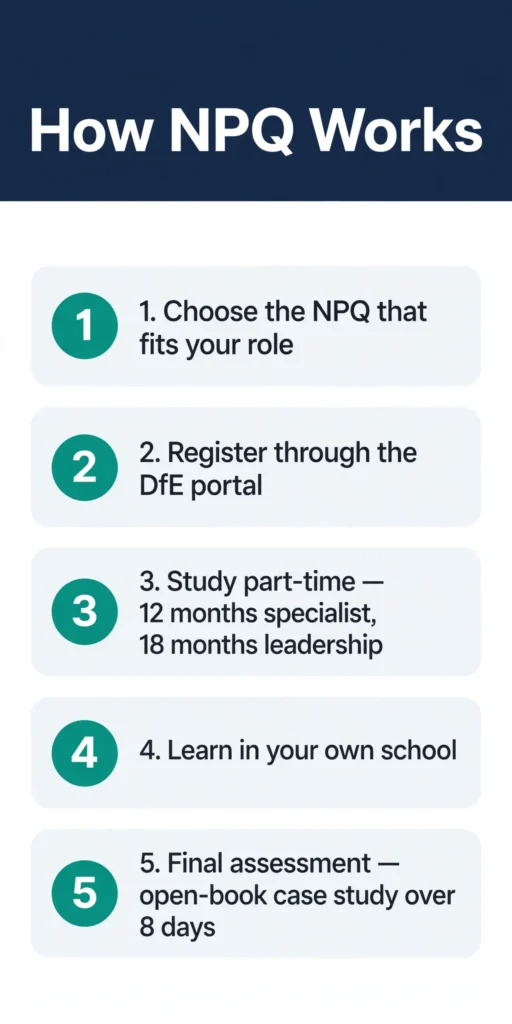
You study part-time, alongside your normal teaching job. A lead provider delivers the course, and the DfE sets the framework. So, you may still be asking: what does NPQ stand for? Here is how it works, step by step:
- Choose the NPQ that fits your role. Pick a specialist one for a teaching area, or a leadership one for a senior role.
- Register through the DfE’s online portal. Then pick a DfE-approved lead provider.
- Study part-time for around 12 months for a specialist NPQ, or around 18 months for a leadership NPQ.
- Learn in your own school as you go. The work links to your real job, not just to theory.
- Finish with a final assessment. It is an open-book case study task, taken over eight days.
Study takes around one to two hours a week, plus live seminars and some face-to-face days. The exact mix depends on your provider.
Funding changes between cohorts, so check GOV.UK before you apply. For autumn 2026, four NPQs are fully funded for teachers in publicly funded schools in England: Headship, Senior Leadership, Early Years Leadership and SENCO. Other NPQs are funded mainly for schools serving disadvantaged communities.
The NPQ Suite at a Glance
The suite has five specialist NPQs. Each one deepens your skill in one area of teaching:
- Leading Teaching (NPQLT) — for teachers who lead teaching in a subject, year group or phase.
- Leading Behaviour and Culture (NPQLBC) — for teachers who lead behaviour and pupil wellbeing.
- Leading Teacher Development (NPQLTD) — for teachers who lead the training of other teachers.
- Leading Literacy (NPQLL) — for teachers who lead literacy across a school or phase.
- Leading Primary Mathematics (NPQLPM) — for primary teachers who lead maths.
The suite also has five leadership NPQs. Each one prepares you for a senior role:
- Senior Leadership (NPQSL) — for leaders with cross-school responsibilities.
- Headship (NPQH) — for current and aspiring headteachers.
- Executive Leadership (NPQEL) — for executive headteachers and trust chief executives.
- Early Years Leadership (NPQEYL) — for leaders of nurseries and early years settings.
- SENCO (NPQ SENCO) — for special educational needs coordinators.
Where Is NPQ Used?
NPQs are used in schools across England. That includes primary and secondary schools, academies and multi-academy trusts. The Early Years Leadership NPQ is used in nurseries and early years settings too.
NPQs are not used in Scotland, Wales or Northern Ireland. Each of those nations runs its own system. If you teach in Scotland, for example, you follow the Scottish route, not the NPQ route.
What NPQ Has Achieved
NPQs have become the usual route into school leadership in England. Teachers commonly take NPQSL around the assistant or deputy head stage. They commonly take NPQH before or during their first headship.
One NPQ is now a legal requirement. Since 1 September 2024, a new SENCO in a mainstream school must complete the NPQ for SENCOs within three years of starting the role. It replaced the old National Award for SEN Coordination.
The reformed NPQs sit inside a wider set of reforms. Together they form a “golden thread” of development that runs through a teacher’s whole career, from early career to headship.
The DfE still reviews the suite. In February 2025 it announced a review of all ten NPQs, to check they still meet schools’ needs. The review looks at SEND, leadership progression, workload and operational leadership.
Where Did NPQ Come From?
The story starts in 1997. The first NPQ was the one for headship, introduced by the new Labour government. It set a national standard for what a headteacher should know.
From 2002, the National College for School Leadership ran the NPQs. The headship NPQ became mandatory for new heads in 2009. That rule was dropped in 2012, and NPQH became voluntary again.
In autumn 2021, the DfE reformed the whole suite. Three leadership NPQs were rebuilt around the best available evidence.
The old middle leadership NPQ was removed. New specialist NPQs took its place.
Two more NPQs joined in autumn 2022: Leading Literacy and Leading Primary Mathematics. The SENCO NPQ followed on 1 September 2024. The suite has ten qualifications today.
NPQ vs PGCE
People often mix up NPQ and PGCE. They sit at different points in a teacher’s career.
| NPQ | PGCE | |
|---|---|---|
| What it is | Professional development for working teachers | Initial teacher training |
| When you take it | After you are already teaching | Before you start teaching |
| What it gives you | Leadership or specialist skills | A postgraduate certificate, usually with QTS |
| Who runs it | DfE-approved lead providers | Universities and teacher training providers |
QTS is the status that lets you teach in most schools in England. A PGCE usually comes with QTS.
An NPQ does not give you QTS. You need QTS first, then you can take an NPQ.
Scotland uses the PGDE instead of the PGCE. It is the Scottish equivalent, and Linktova explains it in the PGDE post.
Key Terms
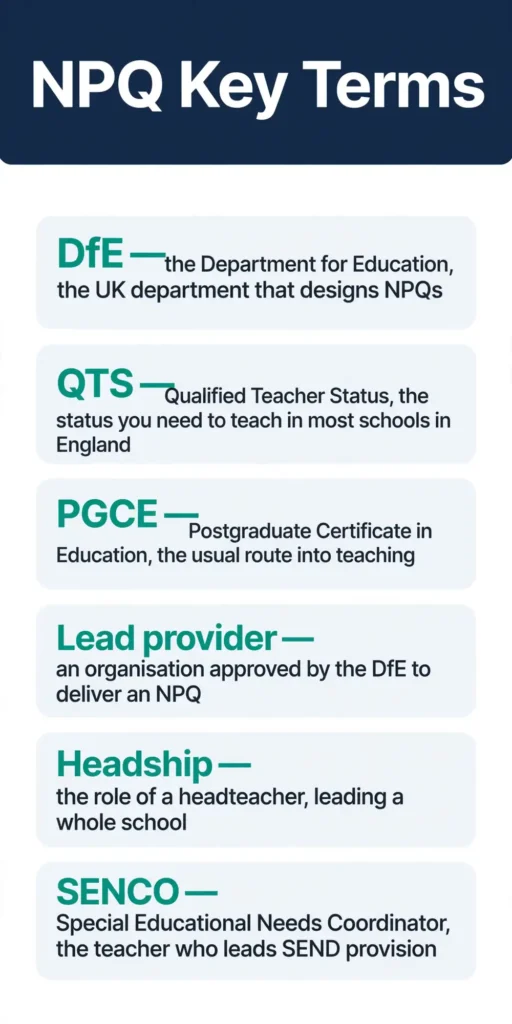
- DfE — the Department for Education, the UK government department that designs NPQs.
- QTS — Qualified Teacher Status, the status you need to teach in most schools in England.
- PGCE — Postgraduate Certificate in Education, the usual route into teaching in England.
- Lead provider — an organisation approved by the DfE to deliver an NPQ.
- Headship — the role of a headteacher, leading a whole school.
- SENCO — Special Educational Needs Coordinator, the teacher who leads SEND provision in a school.
FAQs: What Does NPQ Stand For?
Is an NPQ mandatory?
No, not usually. NPQs are voluntary.
The one exception is the NPQ for SENCOs. A new SENCO in a mainstream school must complete it within three years of starting the role.
How long does an NPQ take?
A specialist NPQ takes around 12 months. A leadership NPQ takes around 18 months. You study part-time, alongside your teaching job.
Is NPQ only for England?
Yes. NPQs apply to England. Scotland, Wales and Northern Ireland have their own systems for teacher development.
Do I need QTS before I take an NPQ?
NPQs are for teachers and leaders who already work in schools. In a mainstream school, that means you already hold QTS. Check the rules for your NPQ and your setting before you apply.
See also
Conclusion
NPQ stands for National Professional Qualifications. It is a suite of ten qualifications for teachers and leaders in England. If you want to lead a subject, a phase or a whole school, an NPQ is the route most teachers take. So, if anyone asks you what does NPQ stand for, you can now answer with confidence.

Founder & Editor, Linktova. Arshad Ullah is the Founder & Editor at Linktova. He has previously worked on vocabulary websites and now leads the Linktova Team in explaining what abbreviations stand for — their full forms, meanings, and everyday use — in simple language.