CCTV stands for Closed-Circuit Television.
It is a video system that sends camera footage to a small, private set of monitors. It is not broadcast TV. The signal does not go out to the public.
Quick Reference
| Item | Detail |
|---|---|
| Short form | CCTV |
| Full form | Closed-Circuit Television |
| Type | Initialism — say the letters: “see-see-tee-vee” |
| What it is | Cameras that send video to a limited set of monitors |
| Where you see it | Shops, homes, workplaces, schools, streets |
| Not the same as | Broadcast TV, or every IP camera system (see below) |
Pronunciation
CCTV is pronounced “see-see-tee-vee” — say the letters one by one, not as one word.
Acronym or Initialism?
CCTV is an initialism. You read it letter by letter: C-C-T-V. You do not read it as one word. People often call every initialism an “acronym” in everyday speech, but the strict reading here is letter by letter.
What Is CCTV?
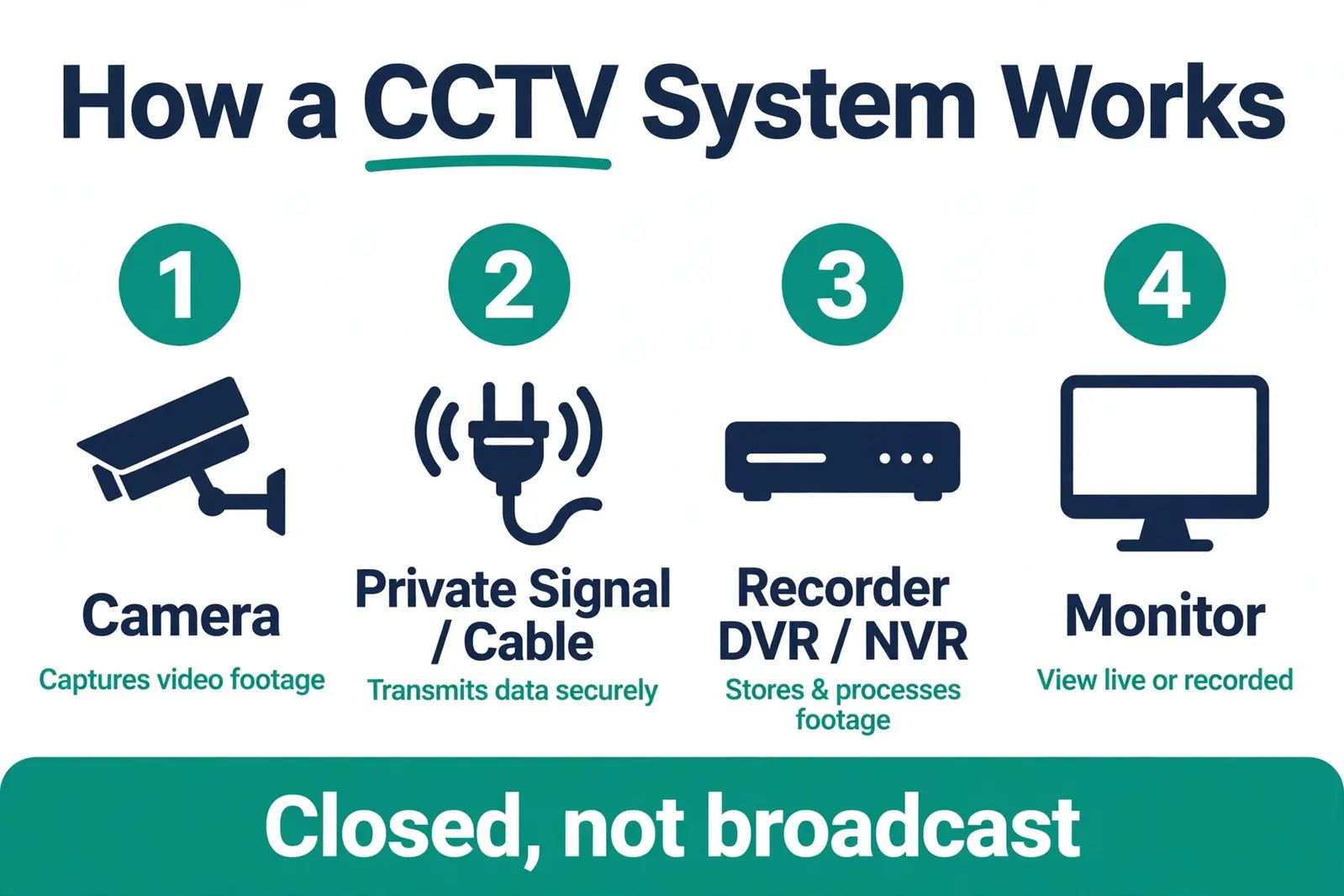
A CCTV system has three basic parts: cameras, a way to send the video, and a place to watch or record it. The camera captures the scene. The signal travels to a recorder or monitor. Only the people with access to that system can watch it.
That “closed” part is the whole idea. With broadcast TV, anyone with a TV can tune in. With CCTV, the video stays inside its own system. That is why shops, offices and homes use it for security and monitoring.
What CCTV Does, Where It Is Used, and What It Has Achieved
What it actually does
CCTV watches, records, and plays back video from a private system. A guard or shop owner can watch it live. A recorded clip can be checked later, after an incident. That clip can show what happened, when it happened, and who was there.
Modern systems can also send an alert, or let the owner check the video on a phone. But the basic job has not changed: see what is happening, keep a record, and use that record when it is needed.
Where it is used
CCTV is used in many places, for the same basic reasons — safety, control, and evidence:
- Homes — doors, driveways, and gardens, to deter intruders and check deliveries.
- Shops and malls — entrances, tills, aisles, and car parks, to deter theft and check incidents.
- Banks and ATMs — to monitor transactions and deter robbery and fraud.
- Schools and universities — entrances, halls, and grounds, for student safety.
- Streets, parks, and car parks — to monitor public areas and traffic.
- Transport — stations, buses, and trains, to protect passengers and staff.
- Workplaces, warehouses, and factories — to monitor entrances, stock areas, and safety.
What it has achieved
CCTV has not stopped all crime, and the evidence is mixed by crime type. The strongest published summary is the College of Policing’s review of 76 studies. It found crime was 13% lower in places with CCTV than in places without it. Drug-related crime was 20% lower, and vehicle and property crime was 14% lower. The effect was strongest in car parks, and active monitoring worked better than a passive, unwatched system. The same review found no clear overall effect on violent crime or disorder.
Footage has also helped investigations directly. In a Northumbria Police case published by the College of Policing in April 2026, five masked men broke into homes to steal car keys. Doorbell footage alone did not identify them. CCTV from the nearest metro station showed their faces, and cross-checking that footage with other video led to identifications, arrests, charges, and guilty pleas. CCTV did not solve that case on its own — it was one part of the evidence — but without it, the suspects had left almost no physical evidence.
What CCTV cannot do
A camera alone does not stop a crime. It needs a clear picture, a working recording, and someone who can watch or retrieve it. If the picture is poor, or the recording is missing, the footage may prove little. And CCTV raises a privacy question too: people in a shop, street, or workplace may not want to be recorded, even when the camera is there for safety.
Where Did CCTV Come From?
CCTV did not start as a shop security tool. It started with a technical problem: how to watch something dangerous from a safe distance.
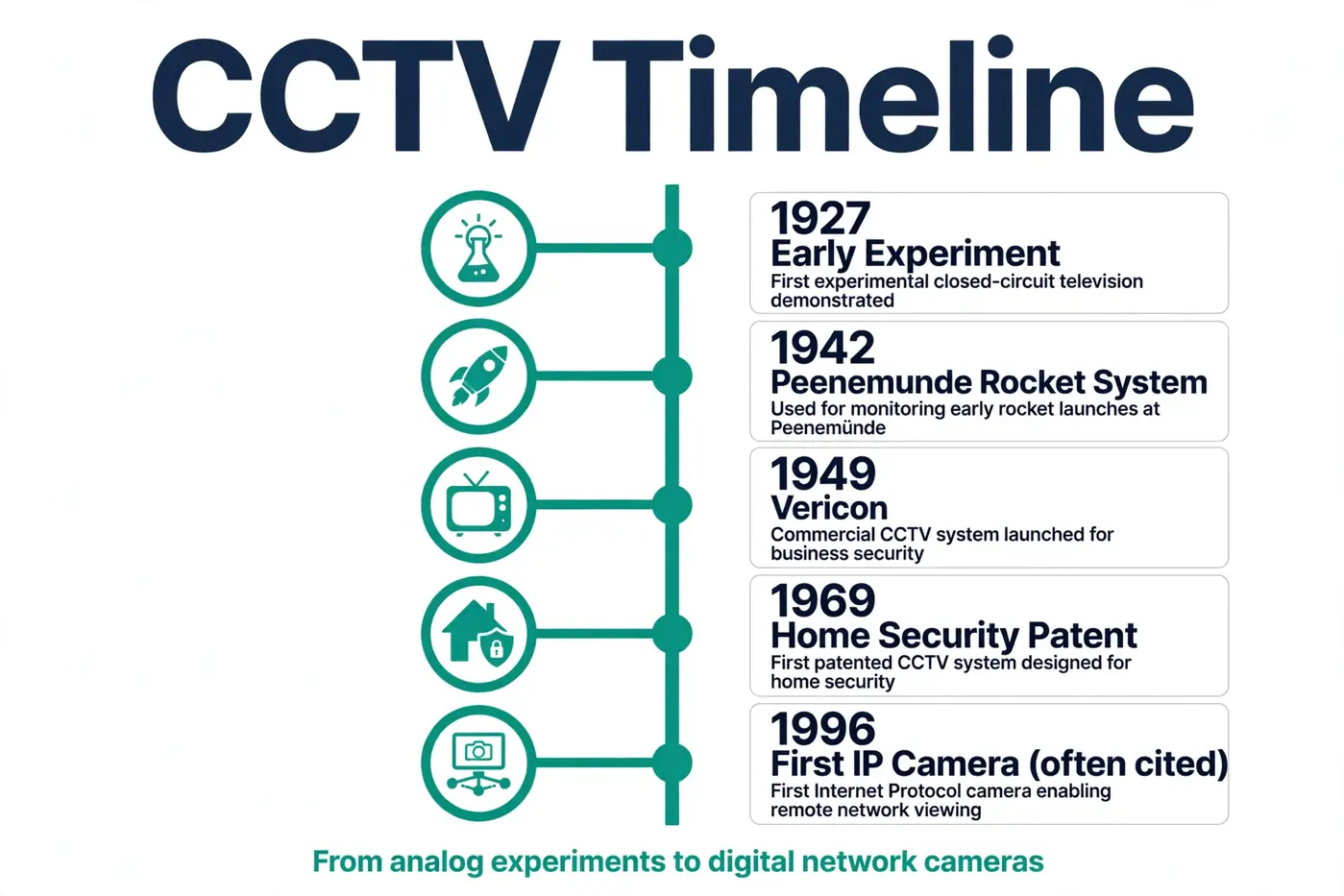
An early experiment came in 1927, when Russian inventor Leon Theremin developed what many consider the first CCTV system. The first operational system came later, in 1942. Siemens installed it at Peenemünde in Germany to observe V-2 rocket launches. German engineer Walter Bruch designed and installed it. Those early systems could only show live video. They could not record it.
The first commercial system in the United States appeared in 1949. It was called Vericon. Very little is known about it today, except that it was advertised as not needing a government permit. By 1969, home security had arrived too: Marie Van Brittan Brown’s home security system patent was granted that year.
How CCTV Has Changed Over Time
The change is real, so it is included here — and it is only the change the sources support. Early CCTV was analog. A camera sent a continuous signal over a coaxial cable to a recorder (a DVR). The picture was basic, and the system stayed in one building.
Modern systems are often IP-based. An IP camera turns video into digital data at the camera itself. It then sends that data over a network cable or Wi-Fi to a recorder (an NVR) or to cloud storage. The first IP camera is often cited as the Axis NetEye 200 in 1996. Today, IP systems can offer sharper video, phone viewing and smart alerts — but the old word “CCTV” is still used for the whole field.
CCTV vs IP Camera — Not To Be Confused With
In the strict sense, traditional CCTV means analog cameras, coaxial cable and a DVR. An IP camera system means network cameras, Ethernet or Wi-Fi, and an NVR or cloud storage. They are not the same technology, even though both record video for security.
In everyday speech, though, people use “CCTV” for almost any security camera system, including IP ones. So if a shop says “CCTV in operation”, it may mean an old analog system or a modern IP system. The word tells you the purpose — private video monitoring — not the exact wiring inside.
Used in a Sentence
- “The shop checked its CCTV footage after the delivery went missing.”
- “CCTV cameras monitor the car park at night.”
- “Our office uses CCTV, but only managers can view the recordings.”
FAQs
What does CCTV stand for?
CCTV stands for Closed-Circuit Television.
Is CCTV the same as a security camera?
Mostly, yes, in everyday speech. In the strict sense, CCTV is the closed system — camera, private signal, limited monitors — while “security camera” is the broader word for any camera used for security, including IP cameras.
Can anyone watch CCTV footage?
No. That is the “closed” part. Only people with access to that system can watch it. Who exactly that is depends on the owner of the system.
Does CCTV always record?
No. Early systems were live-only. Most modern systems record, but a system set to live viewing only still counts as CCTV.
Conclusion: What Does CCTV Stand For?
CCTV stands for Closed-Circuit Television. It is video that stays inside its own system, for a limited set of viewers, instead of being broadcast to the public. It started with rocket launches in 1942, moved into shops and homes, and today often runs on modern IP technology — while keeping its old name.

Founder & Editor, Linktova. Arshad Ullah is the Founder & Editor at Linktova. He has previously worked on vocabulary websites and now leads the Linktova Team in explaining what abbreviations stand for — their full forms, meanings, and everyday use — in simple language.