What does OD stand for? OD has more than one full form. Its most common meaning in eye care is Oculus Dexter, the right eye.
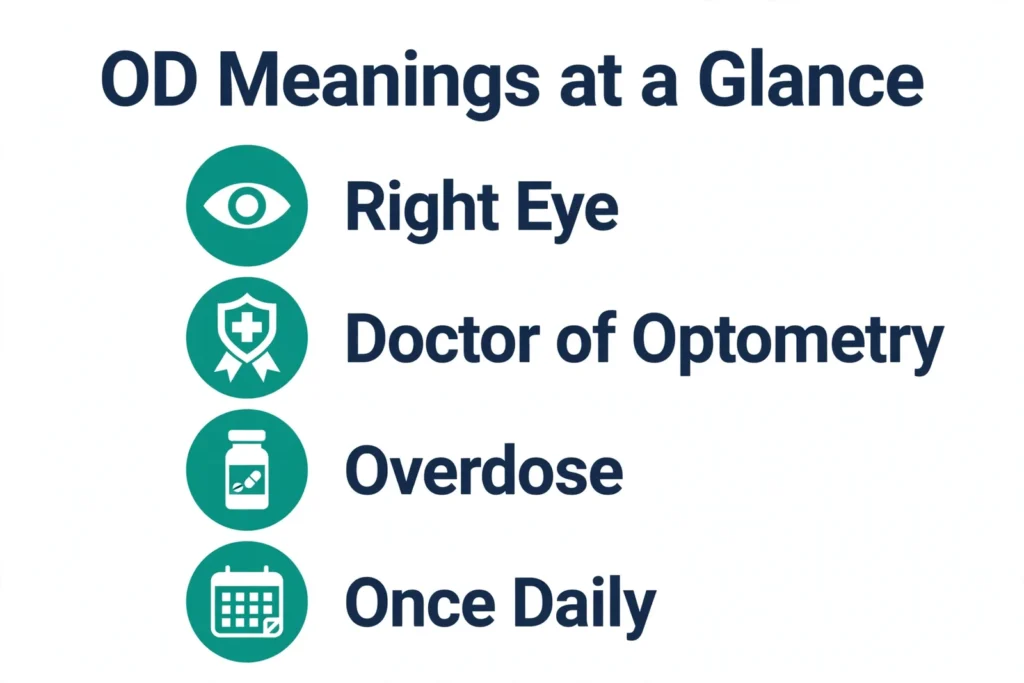
The right meaning depends on where you see OD. For example, on an eye prescription, it means the right eye. After a person’s name, it means Doctor of Optometry. In other places, it can mean overdose, once daily, or something else entirely. This article starts with a short table, then explains each main meaning in turn.
Quick Reference
| Meaning | Full form | Where you see it |
|---|---|---|
| Right eye | Oculus Dexter | Eye prescriptions and eye-care notes |
| Eye doctor | Doctor of Optometry | After an optometrist’s name (O.D.) |
| Too much medicine | Overdose | Health news and emergency care |
| Once a day | Omne in die | Old medicine instructions |
| Pipe size | Outside Diameter | Engineering and plumbing |
| Light | Optical Density | Physics and lab work |
Pronunciation
OD is said letter by letter: “oh-dee”. It is not said as one word.
Acronym or Initialism?
OD is an initialism. You read its letters one by one, “oh-dee”. The word “acronym” is often used loosely for both, but OD is spoken as separate letters, not as a word.
OD as Right Eye
OD stands for Oculus Dexter. That is Latin for “right eye”. On an eye prescription, every value in the OD row belongs to your right eye only.
OD has two close partners. For example, OS stands for Oculus Sinister, the left eye, and OU stands for Oculus Uterque, both eyes. Together, they keep the two eyes apart on paper. That matters, because the two eyes often need different lens powers.
How to read OD on a prescription
- Find the OD row first. It is usually the top row.
- Read the values in that row for your right eye only.
- Then read the OS row for your left eye. Do not mix the two rows.
Read “right” and “left” from your own point of view, not from the point of view of someone facing you. The OD row is your right eye, even if it looks on the left side of the page to someone else.
OD as Doctor of Optometry
O.D. after a person’s name stands for Doctor of Optometry. That person is an optometrist. An optometrist is a primary eye-care professional. They test vision, prescribe glasses and contact lenses, and check for eye disease.
An optometrist usually completes four years of undergraduate study, then four years at a college of optometry. After that, they must pass national board exams and get a licence to practise. However, an optometrist is not a medical doctor (M.D.). Ophthalmologists are medical doctors who specialise in eye care and can do eye surgery. In short, an optometrist and an ophthalmologist do different jobs, and both are part of eye care.
OD as Overdose
OD also stands for overdose. An overdose is a dangerously large amount of a drug, taken at one time. OD is also used as a verb. “To OD” means to take too much of a drug at one time.
An overdose can happen with a prescription drug, a drug bought without a prescription, or an illegal drug. It can also happen by mistake, when a dose is taken too soon after the last one. If someone may have taken too much, get emergency help at once. Do not wait to see if they get better. In emergency care, for example, treatment may include medicines given through an IV line. IV stands for intravenous, and you can read more in our post on IV.
This article gives no dosage or treatment advice. It only explains what the word means.
OD as Once Daily
OD can also mean once daily. It comes from the Latin phrase omne in die, which means “once a day”. A prescription might have read, “Take one tablet OD.”
However, this use is now a safety problem. OD for “once daily” looks exactly like OD for “right eye”. For example, a liquid medicine meant to be swallowed once a day could be read as a medicine for the right eye. The Institute for Safe Medication Practices (ISMP) lists OD for “once daily” as an error-prone abbreviation. It says to write “daily” instead.
Important: OD can mean “right eye” or “once daily”. Never guess. If OD is on your prescription, ask your doctor or pharmacist what it means there.
Other Meanings of OD
In addition, OD has a few more meanings in other fields. They are short, and they depend on the subject.
- Outside Diameter: In engineering and plumbing, OD is the outside width of a pipe, tube, or cylinder. It is measured across the outer edges, not the inside.
- Optical Density: In physics, OD is a measure of how much a material reduces the light that passes through it. A higher OD means less light gets through. Protective eyewear for lasers is rated by OD, and eye protection is one kind of PPE.
- On Duty: At work, OD can mean on duty, or working at that time.
- Organizational Development: In business, OD can mean organizational development, the work of improving how a company is run.
Why OD Matters
OD matters because a small mix-up can cause a real mistake. On an eye prescription, OD keeps the right eye’s values apart from the left eye’s values. After a name, O.D. tells you the person is a trained eye-care professional. On a medicine label, the same two letters can mean two different things, and that is why safety groups ask people to write the words out in full.
Overall, the lesson is simple: when you ask what does OD stand for, do not read OD on its own. Read the place where you found it. The place tells you the meaning.
Where Did OD Come From?
Most meanings of OD come from Latin. Oculus dexter means “right eye”, oculus sinister means “left eye”, and omne in die means “once a day”. Latin was the common language of medicine for a long time, and these short forms stayed in use.
In contrast, OD as overdose is different. It is not from Latin. It is a short, informal form of the English word “overdose”. No single date is claimed here for when any of these uses first appeared, because no such date was verified for this post.
OD vs OS
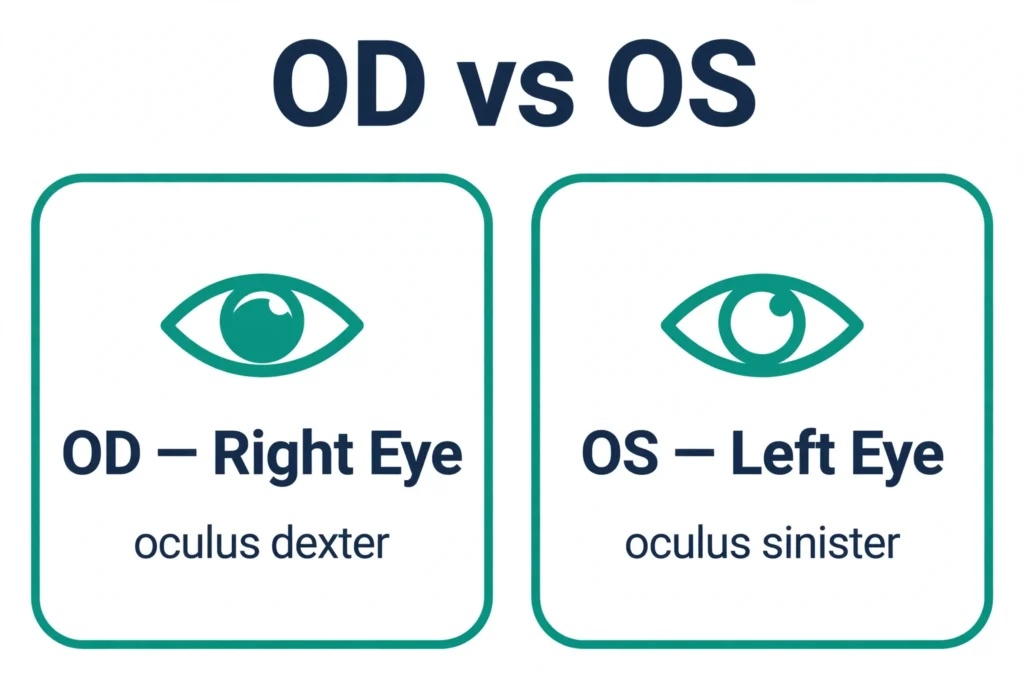
OD and OS are easy to mix up, but they are opposites.
- OD is the right eye (oculus dexter).
- OS is the left eye (oculus sinister).
- OU is both eyes (oculus uterque).
However, OD and OS are labels, not measurements. They do not tell you how strong a prescription is. They only tell you which eye each value belongs to.
Myth vs Fact
Myth: OD always means the right eye.
Fact: OD means the right eye in eye care, but it can mean once daily, overdose, or something else in other places. The context decides.
Myth: A person with O.D. after their name is a medical doctor.
Fact: O.D. means Doctor of Optometry. An optometrist is an eye-care professional, not a medical doctor (M.D.).
Myth: OD for “once daily” is safe to use on a prescription.
Fact: ISMP lists it as error-prone, because it can be read as “right eye”. The safe choice is to write “daily” in full.
Used in a Sentence
- “What does OD stand for? On my prescription, OD stands for oculus dexter, the right eye.”
- “Dr. Lee, O.D., tested my vision and prescribed new glasses.”
- “The label said to take one tablet OD, once daily.”
FAQs: What Does OD Stand For?
What does OD stand for?
OD has more than one meaning. In eye care, it most often stands for Oculus Dexter, the right eye. It can also stand for Doctor of Optometry, overdose, or once daily.
What does OD mean on an eye prescription?
OD means the right eye. The values in the OD row belong to your right eye only. OS means the left eye, and OU means both eyes.
What does O.D. mean after a doctor’s name?
O.D. means Doctor of Optometry. That person is an optometrist, a primary eye-care professional who tests vision and prescribes glasses and contact lenses.
Is OD for “once daily” still used?
It is still seen on old prescriptions, but safety groups say not to use it. ISMP lists OD for “once daily” as error-prone, because it can be read as “right eye”. Write “daily” instead.
See also
- IV Stands For – Full Form, Meaning and Examples
- PPE Stands For – Full Form, Meaning and Examples
- OSHA Stands For – Full Form, Meaning and Examples
Conclusion: What Does OD Stand For?
OD stands for more than one thing, and the place where you see it tells you which one it is. That is the short answer to what does OD stand for. On an eye prescription, OD stands for Oculus Dexter, the right eye. After a name, O.D. stands for Doctor of Optometry. In other places, however, it can mean overdose, once daily, outside diameter, or optical density. When you are not sure, ask. With OD, a short question can prevent a costly mistake.

Founder & Editor, Linktova. Arshad Ullah is the Founder & Editor at Linktova. He has previously worked on vocabulary websites and now leads the Linktova Team in explaining what abbreviations stand for — their full forms, meanings, and everyday use — in simple language.