What does ROTC stand for? ROTC stands for Reserve Officers’ Training Corps.
In simple words, ROTC is a college programme that trains students to become officers in the United States Armed Forces. Students study for their normal degree and take military training at the same time. When they finish, they can serve as commissioned officers. In short, ROTC turns a college student into a future officer.
Quick Reference
| Item | Detail |
| Full form | Reserve Officers’ Training Corps |
| Short form | ROTC |
| Read as | Acronym — “rot-see”, also read as “R-O-T-C” |
| What it is | College officer-training programme |
| For whom | College and university students |
| Branches | Army, Naval, Air Force |
| Leads to | Commission as an officer |
| Not ROTC | JROTC (high school) |
Pronunciation
Most people say ROTC as a word: “rot-see”. Some people read the letters one by one: “R-O-T-C”. Both are used, and both are correct.
Acronym or Initialism?
ROTC is an acronym. Most people say it as one word, “rot-see”. The word “acronym” is often used loosely for both, but ROTC is spoken as a word, not just as separate letters.
What Is ROTC?
ROTC is a group of college programmes run with the United States Armed Forces. Each programme trains students to lead soldiers, sailors, or airmen. Students attend normal college classes for their degree. They also attend military classes, drills, and summer training.
ROTC is not a single school. It is a set of programmes at many colleges and universities. Each college unit belongs to one branch: Army, Naval, or Air Force. The student joins one branch and trains for that branch.
How ROTC Works
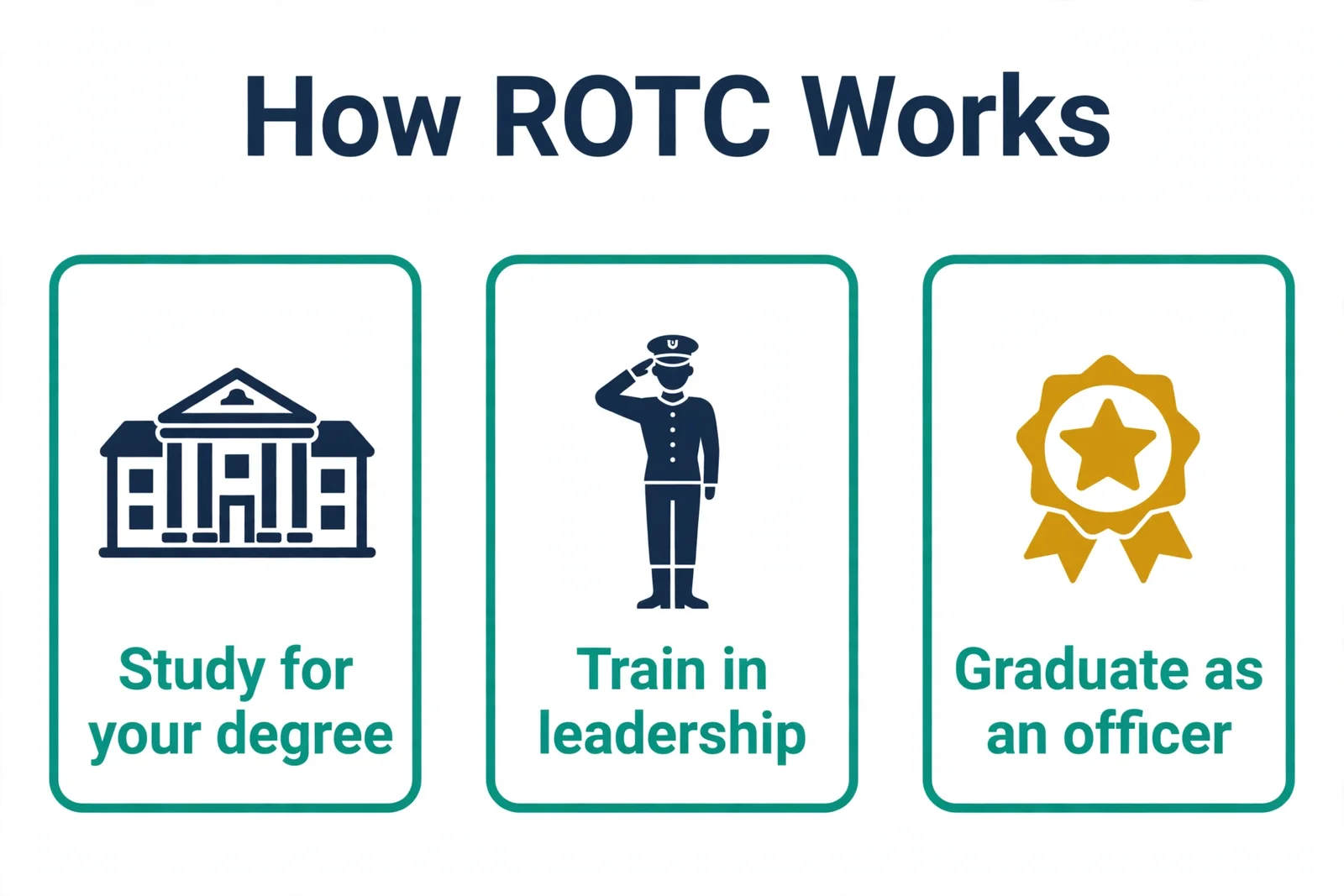
- Teaches leadership — cadets learn how to lead a team, make decisions, and stay calm under pressure.
- Teaches military skills — these include fitness, first aid, map reading, and field training.
- Prepares students for service — when a cadet finishes college and the programme, they receive a commission. That means they become an officer in their branch.
Cadets also get support during college. Many receive scholarships that help pay for tuition. Some receive a monthly stipend. In return, they agree to serve as officers after they graduate. The exact terms depend on the branch and the scholarship.
Where Is ROTC Used?
ROTC is used at colleges and universities across the United States. Each unit is based at one college, and students from nearby colleges may join it too.
- Army ROTC — the largest programme, at many colleges and universities.
- Naval ROTC (NROTC) — trains officers for the Navy and the Marine Corps.
- Air Force ROTC — trains officers for the Air Force and the Space Force.
Students join ROTC in their first or second year of college. They train during term time and at summer camps. After four years, they graduate with a degree and a commission.
What ROTC Has Achieved
ROTC gave the United States a steady source of officers from civilian colleges. Before ROTC, most officers came from military academies. ROTC opened the path to students at ordinary colleges. That made the officer corps wider and more varied.
ROTC also linked civilian life with military service. A student can study engineering, history, or science, and still train to lead.
Many officers who served in the Army, Navy, and Air Force began in ROTC. No single number is claimed here for how many officers ROTC has produced, because that figure changes over time and was not verified for this post.
The achievement is the path itself: a college student can become an officer without leaving civilian college behind.
Where Did ROTC Come From?
ROTC did not start in one year. It grew over a century, from an idea to a formal programme.
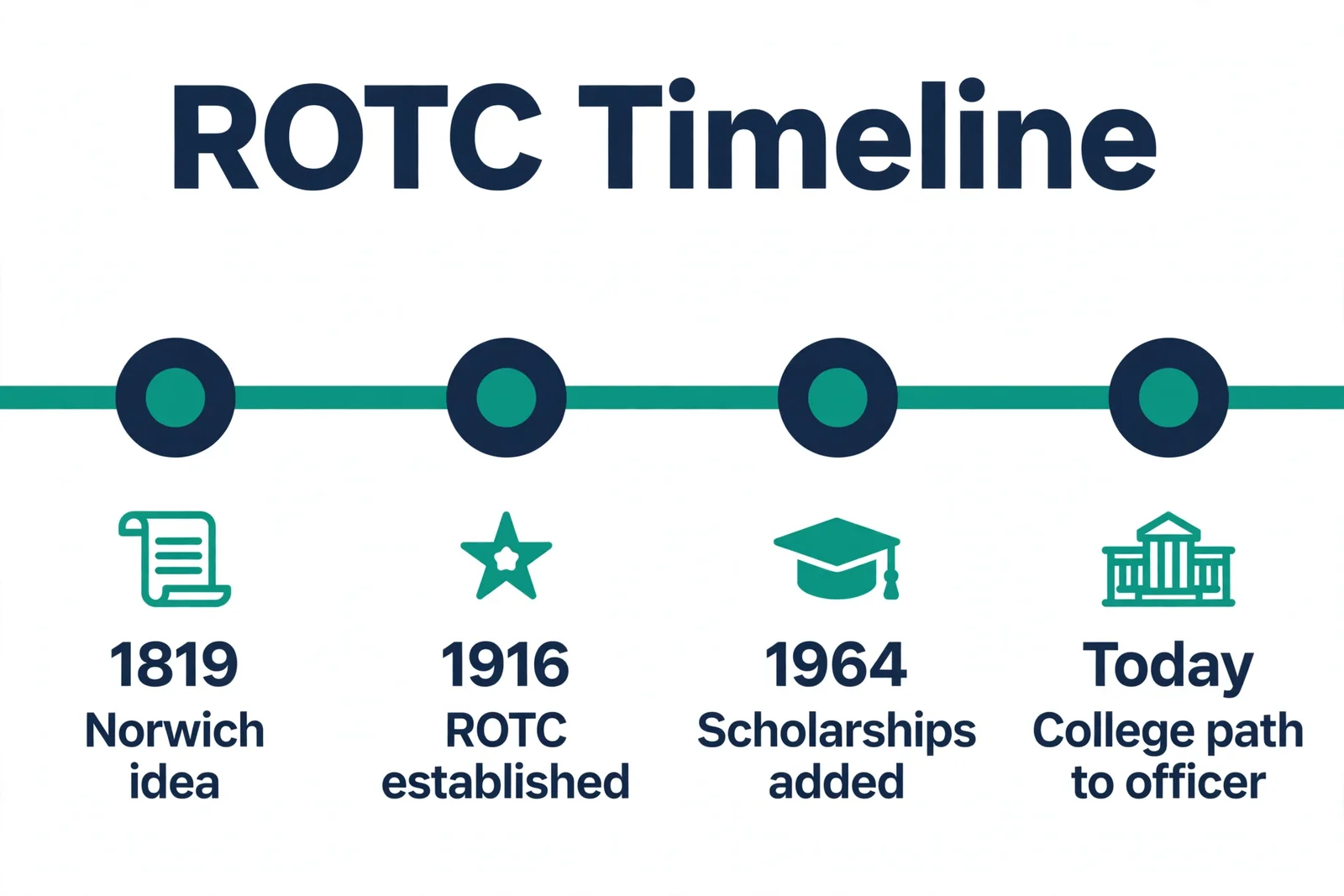
The idea began with Alden Partridge, who founded Norwich University in 1819 as the American Literary, Scientific, and Military Academy. He believed civilian colleges should train citizen-soldiers. His idea spread to other colleges.
In 1862, the Morrill Act required land-grant colleges to include military tactics in their teaching. This put military training into civilian colleges across the country. The Act was signed on 2 July 1862.
In 1915, the Plattsburg Movement, led by Major General Leonard Wood, ran Citizen’s Military Training Camps. Civilians trained there to become officers. The camps showed that civilian training could work.
The National Defense Act of 1916 formally established ROTC. It was signed on 3 June 1916. The first ROTC unit was at Harvard University in 1916.
The National Defense Act of 1920 established JROTC, a programme for high-school students. It is separate from ROTC, which is for college students.
In 1964, the ROTC Vitalization Act changed the programme again. It added scholarships and stipends, and made ROTC the military’s primary source of active-duty officers.
In 1986, Army ROTC Cadet Command was established. It brought Army ROTC units under one command, so training became more standard across colleges.
How ROTC Has Changed Over Time
ROTC changed in three clear ways. First, it moved from an idea to a law. Partridge’s idea became the Morrill Act, and then the National Defense Act of 1916 made ROTC a formal programme. Second, it grew from a few colleges to many. Scholarships and stipends, added in 1964, made it open to more students. Third, it became more standard. Cadet Command, set up in 1986, gave Army ROTC one command and one set of training standards.
Today, ROTC is still a college programme, but it is now a formal, funded path to becoming an officer. The core idea has not changed: a civilian student trains to lead.
ROTC vs JROTC
ROTC and JROTC are easy to confuse. They share a name, but they are for different students.
- ROTC is for college and university students. It leads to a commission as an officer after graduation.
- JROTC is for high-school students. It teaches leadership and citizenship, but it does not lead to a commission. JROTC students are not required to join the military.
In short, ROTC trains future officers at college. JROTC teaches leadership at high school.
Army vs Naval vs Air Force ROTC
ROTC has three branches. Each trains officers for its own service.
- Army ROTC trains officers for the Army. It is the oldest and largest of the three.
- Naval ROTC (NROTC) trains officers for the Navy and the Marine Corps. NROTC was founded in 1926, and the Marine Corps joined the programme in 1932.
- Air Force ROTC trains officers for the Air Force and the Space Force.
Each branch has its own classes, drills, and summer training. The student picks one branch and trains for it. They cannot train for two branches at the same time.
Key Terms
- ROTC — Reserve Officers’ Training Corps, a college officer-training programme.
- Cadet — a student in ROTC training to become an officer.
- Commission — appointment as an officer after graduation.
- JROTC — Junior Reserve Officers’ Training Corps, a high-school leadership programme.
- Branch — one of the services: Army, Naval, or Air Force.
- Stipend — a monthly payment some cadets receive during college.
What ROTC Cannot Do
ROTC cannot make a student an officer on its own. The student must also finish a college degree and meet the fitness, medical, and academic standards of their branch. If a student leaves college or fails the standards, they do not receive a commission.
ROTC also does not guarantee a specific job. An officer’s job depends on the branch’s needs, the student’s skills, and the results of their training. ROTC opens the path, but the student must walk it.
Not To Be Confused With
- JROTC: A high-school leadership programme. It does not lead to a commission.
- Military academy: A full-time military college, such as West Point or Annapolis. ROTC students study at civilian colleges, not at an academy.
- Enlisted service: Joining as an enlisted soldier, sailor, or airman. ROTC leads to a commission as an officer, not to enlisted service.
Myth vs Fact
Myth: ROTC students are already in the military.
Fact: ROTC students are college students. They train with the military, but they become officers only after they graduate and receive a commission.
Myth: ROTC is only for students who want to fight.
Fact: ROTC trains leaders for many roles, including engineering, medicine, logistics, and intelligence, not only combat roles.
Myth: ROTC and JROTC are the same thing.
Fact: ROTC is for college students and leads to a commission. JROTC is for high-school students and does not lead to a commission.
Used in a Sentence
- “ROTC stands for Reserve Officers’ Training Corps, a college programme for future officers.”
- “She joined Army ROTC in her first year of college.”
- “After graduation, he received his commission through ROTC.”
FAQs
What does ROTC stand for?
ROTC stands for Reserve Officers’ Training Corps. It is a college programme that trains students to become officers in the United States Armed Forces.
Is ROTC only for the Army?
No. ROTC has three branches: Army ROTC, Naval ROTC, and Air Force ROTC. Each trains officers for its own service.
What is the difference between ROTC and JROTC?
ROTC is for college students and leads to a commission as an officer. JROTC is for high-school students and teaches leadership, but it does not lead to a commission.
Do ROTC students have to join the military after college?
Students who accept a scholarship or a commission agree to serve as officers after they graduate. The exact terms depend on the branch and the scholarship.
Key takeaway
ROTC turns a college student into a future officer: study for a degree, train in leadership and military skills, and graduate with a commission.
See also
Conclusion: What Does ROTC Stand For?
ROTC stands for Reserve Officers’ Training Corps. It is a college programme that trains students to lead in the Army, Navy, or Air Force. A student studies for a degree, trains in leadership and military skills, and graduates as an officer.
That path — from a civilian college to a commission — is what ROTC has offered since 1916.

Founder & Editor, Linktova. Arshad Ullah is the Founder & Editor at Linktova. He has previously worked on vocabulary websites and now leads the Linktova Team in explaining what abbreviations stand for — their full forms, meanings, and everyday use — in simple language.
Pingback: What Does PGDE Stand For? Full Form, Meaning and Examples | Linktova
Pingback: What Does FCCLA Stand For? – Full Form, Meaning and Examples | Linktova
Pingback: What Does FBLA Stand For? – Full Form, Meaning and Examples | Linktova