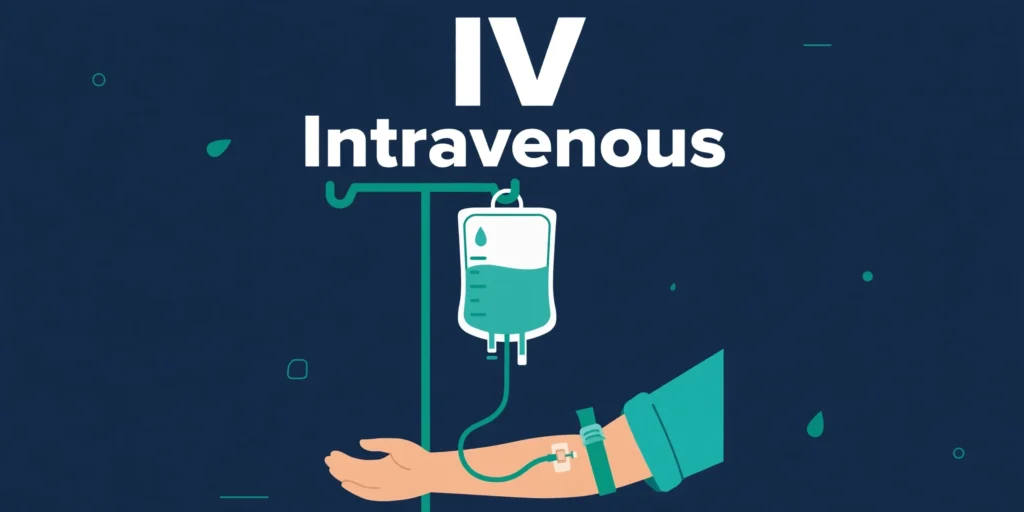
What does IV stand for? IV stands for Intravenous.
In simple words, IV means giving fluids, medicines, or nutrients directly into a vein. A thin tube, called a catheter, carries the fluid into the bloodstream. In short, IV skips the stomach and works fast, because the fluid goes straight into the blood.
Quick Reference
| Item | Detail |
|---|---|
| Full form | Intravenous |
| Short form | IV |
| Read as | Initialism — “eye-vee” |
| Main use | Fluids, medicines, blood, or nutrients into a vein |
| Given by | Trained medical staff, in a clinical setting |
| Not IV | A pill, an injection into muscle, or a drink |
Pronunciation
Say IV letter by letter: “eye-vee”. Do not say it as one word.
Acronym or Initialism?
IV is an initialism. You read its letters one by one. The word “acronym” is often used loosely for both, but IV is not spoken as a word.
What Is IV?
IV is a way to deliver treatment through a vein. A clinician places a small needle in a vein, usually in the hand or arm.
Then a soft plastic catheter stays in the vein. The needle comes out. The catheter connects to tubing and a fluid bag, or to a pump that controls the flow.
The fluid then moves into the bloodstream. It can be water with salts, a medicine, blood, or liquid food. Because it goes straight into the blood, it spreads fast through the body. For this reason, doctors use IV when a patient needs help quickly, or cannot take a pill or drink.
How IV Works
- Replaces fluid — a patient who lost fluid from illness, surgery, or heat can get fluid back fast.
- Delivers medicine — antibiotics, pain relief, and many other drugs can go in through IV.
- Gives nutrition or blood — when a patient cannot eat or drink enough, or has lost blood.
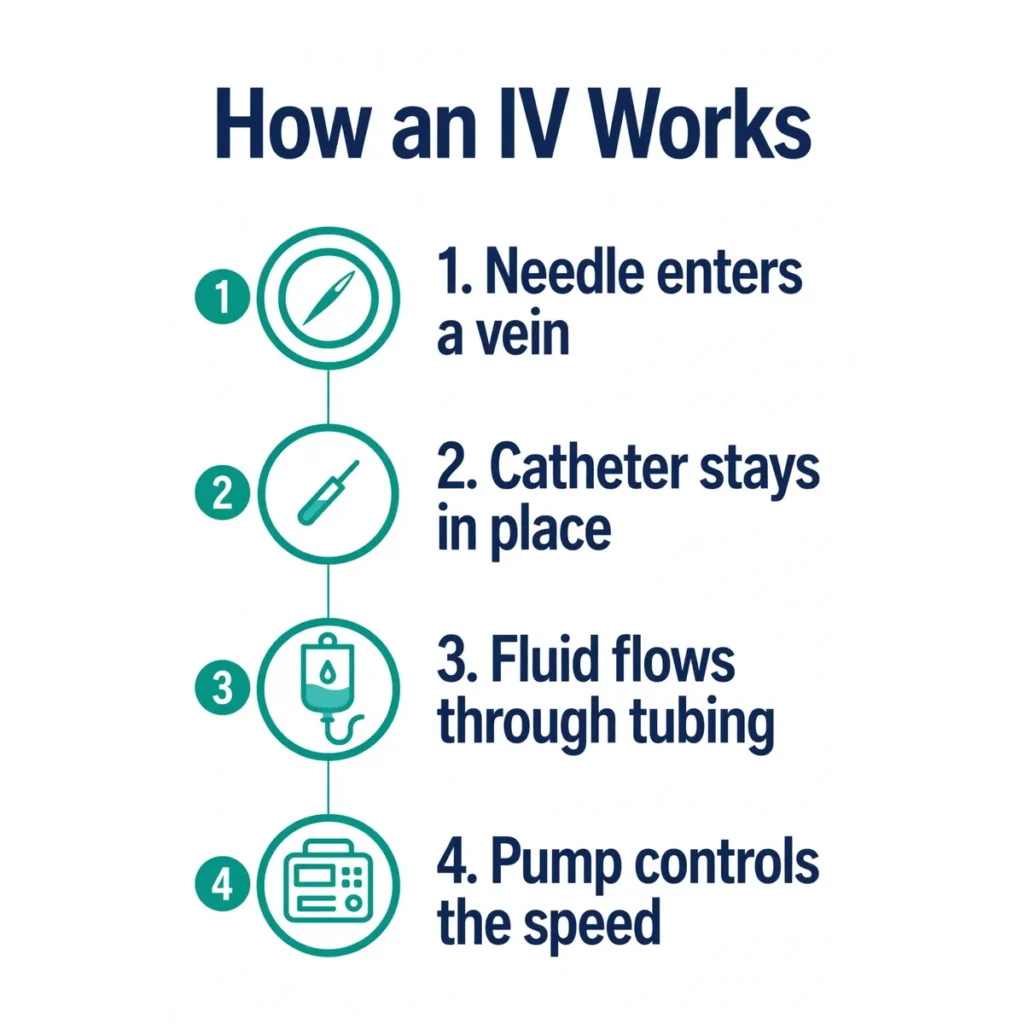
In short, IV gives the body what it needs, in the right amount, at a controlled speed. A pump or a drip can set that speed. A clinician watches the patient, checks the line, and stops or changes the fluid when needed.
Where Is IV Used?
IV is used in supervised clinical settings, where trained staff can watch the patient.
- Hospitals — wards, intensive care, and recovery after surgery.
- Emergency care — fast fluids and drugs when time matters.
- Surgery — fluids and medicines during and after an operation.
- Dehydration — when a patient cannot drink enough, or has lost a lot of fluid.
- Chemotherapy — cancer drugs given over hours, under close watch.
- Blood transfusion — donated blood given through an IV line.
IV is a medical treatment, not a home remedy. It must be given by trained staff, with sterile equipment. Do not try to set up an IV at home.
What IV Has Achieved
IV changed hospital care in a clear way. In the 1830s, a saline infusion gave cholera patients fluid they had lost, and some patients who were close to death recovered. That early use showed that fluid given into a vein could save a life.
Since then, safer catheters and controlled pumps made IV routine in hospitals. Today, IV lets doctors treat dehydration, give antibiotics fast, and support patients through surgery and cancer care. It also lets them give blood and liquid food when the body cannot take them by mouth. In short, IV turned a risky early experiment into a standard part of modern care.
Where Did IV Come From?
IV has no single inventor. Its roots go back to the 17th century, when doctors first learned how blood moves through the body.
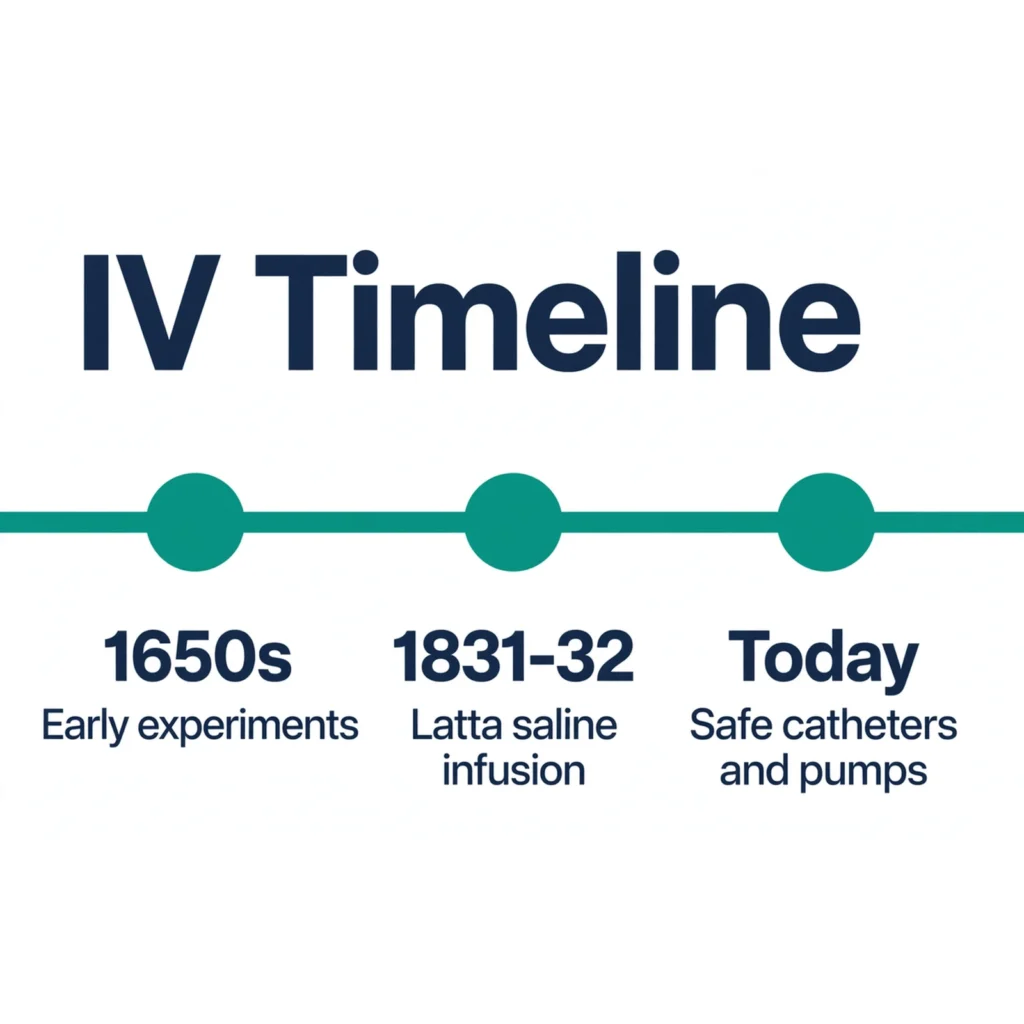
In the 1650s, Christopher Wren, better known as an architect, used a quill and an animal bladder to inject fluids into the veins of dogs. Sources give different years for those first experiments, so this post gives only the decade, not a single year. His work showed that a fluid could travel through the veins.
The next big step came in the cholera epidemic of 1831–32. William O’Shaughnessy, a doctor in Edinburgh, noted that cholera patients lost water and salt from their blood. Thomas Latta, a doctor in Leith, Scotland, then gave a saline solution into a vein. His first patient relapsed and died, but a second patient recovered within two days.
Latta wrote about his work in The Lancet in 1832. That saline infusion became a milestone in IV care.
How IV Has Changed Over Time
IV changed in three clear steps. First, it moved from rough early tools to safer needles and tubes. Early IV used quills, glass, and metal. Later, soft plastic catheters replaced stiff needles, so a line could stay in place with less pain and less damage to the vein.
Second, it moved from a single drip to controlled infusion. Pumps now set the exact speed and amount. That control matters, because too much fluid can also harm a patient. For this reason, IV is always watched by staff.
Third, it moved from short hospital lines to longer-term access. A PICC line, for example, is a longer tube that reaches a large vein near the heart. It lets a patient get treatment over weeks, without a new needle each time. Today, IV is a routine tool, but its core job is the same as in 1832: put fluid into the blood, safely and at the right speed.
IV vs Oral Medicine and Injection
These three routes are not the same.
- IV (intravenous): The drug goes into a vein, straight into the blood. It works fast, and the dose is controlled.
- Oral medicine: You swallow a pill or liquid. It goes through the stomach and liver first, so it works more slowly.
- Injection: A needle puts a drug into muscle or under the skin. It is faster than a pill, but slower than IV, and it gives only one dose at a time.
In short, IV is the fastest route, and it suits patients who need fluid or drugs now, or cannot swallow. A pill suits steady, long-term treatment at home. An injection suits a single, quick dose.
What IV Cannot Do
IV alone does not cure a disease. It delivers fluid or medicine, but the treatment must still match the illness. IV also carries risks, such as infection at the line, a blocked vein, or too much fluid. For this reason, staff check the line, watch the patient, and use sterile technique.
IV also does not replace food, water, and rest. A patient still needs care, monitoring, and follow-up. And IV does not suit every patient or every drug. Some medicines work better as a pill, and some patients do not need a line at all.
Key Terms
- IV — Intravenous, into a vein.
- Catheter — a thin tube that carries fluid into the bloodstream.
- Saline — water with salts, given as IV fluid.
- Drip — fluid given slowly into a vein.
- Pump — a device that controls the speed and amount of IV fluid.
- PICC line — a longer tube that reaches a large vein near the heart.
Other Meanings of IV
IV most often means Intravenous in medicine, but the same letters have other meanings. In Roman numerals, IV means the number 4. In this post, IV means Intravenous, because that is the dominant meaning for health and hospitals.
Not To Be Confused With
- IM injection: Intramuscular, into a muscle. It is not the same as IV, which goes into a vein.
- A blood test: A needle draws blood out for a test. IV puts fluid in.
- A drip at home: A home IV without trained staff is not safe. IV belongs in a clinical setting.
Myth vs Fact
Myth: IV fluids are just water, so anyone can get one.
Fact: IV fluids are medicines with salts and doses. They need a clinician, sterile equipment, and monitoring.
Myth: IV always works faster, so it is always better than a pill.
Fact: IV is faster, but a pill is safer and simpler for many treatments. The right route depends on the patient and the drug.
Myth: Once an IV line is in, you can leave it alone.
Fact: Staff must check the line for infection, blockage, and fluid overload.
Used in a Sentence
- “The nurse started an IV to replace the fluid she had lost.”
- “He received antibiotics through an IV in hospital.”
- “IV stands for Intravenous, which means into a vein.”
FAQs
What does IV stand for?
IV stands for Intravenous. It means into a vein, and it is used for fluids, medicines, blood, or nutrients given straight into the bloodstream.
Is IV only for emergencies?
No. IV is used in emergencies, but also in surgery, cancer care, and routine hospital treatment, always under medical supervision.
Who can give an IV?
Only trained medical staff, with sterile equipment, in a clinical setting.
Is IV the same as an injection?
No. An injection puts a drug into muscle or under the skin. IV puts fluid into a vein, for fast and controlled delivery.
Conclusion: What Does IV Stand For?
IV stands for Intravenous. It is a medical way to put fluids, medicines, blood, or nutrients straight into a vein. It works fast, it is controlled, and it needs trained staff.
That simple idea — deliver treatment into the blood, safely and at the right speed — is why IV is now a standard part of hospital care.

Founder & Editor, Linktova. Arshad Ullah is the Founder & Editor at Linktova. He has previously worked on vocabulary websites and now leads the Linktova Team in explaining what abbreviations stand for — their full forms, meanings, and everyday use — in simple language.
Pingback: What Does OD Stand For? – Full Form, Meaning and Examples | Linktova
Pingback: What Does NIPPV Stand For? – Full Form, Meaning and Examples | Linktova
Pingback: What Does DLCO Stand For? – Full Form, Meaning and Examples | Linktova
Pingback: What Does FEV1 Stand For? – Full Form, Meaning and Examples | Linktova