DLCO stands for Diffusing Capacity of the Lungs for Carbon Monoxide.
It is a lung function test. It checks how well oxygen moves from your lungs into your blood. If you have ever asked what does DLCO stand for, here is the simple answer.
Quick Reference
| Full form | Diffusing Capacity of the Lungs for Carbon Monoxide |
| Also called | Transfer factor (TLCO), mainly in Europe |
| Pronounced | “dee-el-see-oh” |
| Type | Initialism |
| Category | Medical & Healthcare |
Pronunciation
Say DLCO as “dee-el-see-oh”. Say each letter on its own.
Acronym or Initialism?
DLCO is an initialism. You read it letter by letter, not as one word. People often call such terms “acronyms” anyway, but the correct word here is initialism.
What Does DLCO Stand For?
DLCO is a test of how well your lungs pass gas into your blood. It is one of the pulmonary function tests, often called PFTs. If you have ever wondered what does DLCO stand for, it is the name of this lung test.
Every breath you take moves oxygen into tiny air sacs in your lungs, called alveoli. From there, oxygen must cross a thin wall into your blood. DLCO measures how well that crossing works. For example, if the wall is thick or scarred, less oxygen crosses into the blood.
Doctors use carbon monoxide, not oxygen, for the test. It sticks to hemoglobin far more strongly than oxygen does. So a tiny, safe amount of it shows clearly how much gas crossed the wall.
How DLCO Works
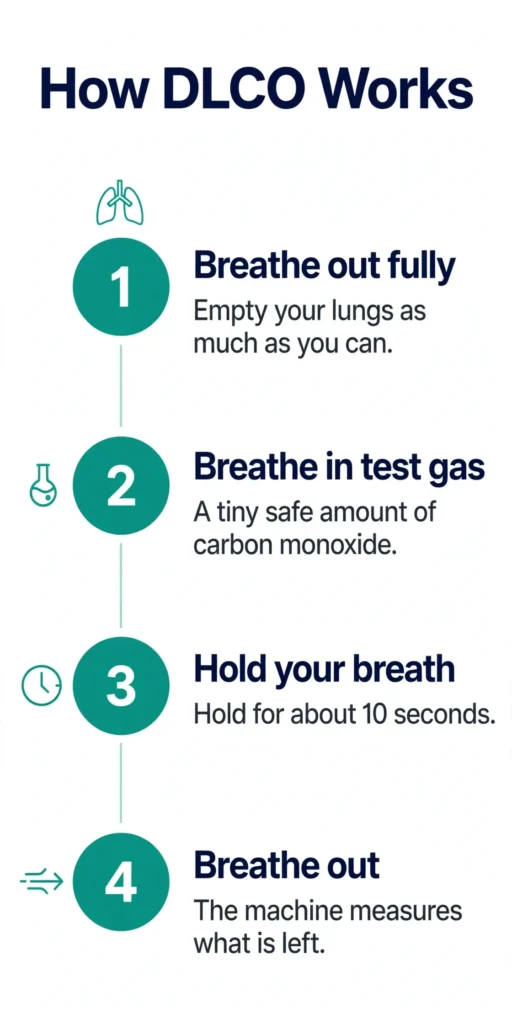
The test uses the single-breath method. You sit and breathe through a mouthpiece. Here is what happens: If you have ever asked what does DLCO stand for, the steps below show how the test works.
- Breathe out fully — so your lungs are as empty as they can be.
- Breathe in a test gas — it holds a very small amount of carbon monoxide, plus a tracer gas.
- Hold your breath for about 10 seconds — during this time, the gas moves into your blood.
- Breathe out — the machine checks how much carbon monoxide is left.
The machine then works out your DLCO from the gas you breathed in and out. Less carbon monoxide left means more of it crossed into your blood.
You wear a nose clip during the test. The technician usually repeats the test at least once, after a few minutes.
The amount of carbon monoxide is tiny and safe. Your clinic may ask you not to smoke first, because smoke can change the result.
How to Prepare for a DLCO Test
- Do not smoke for 4 to 6 hours before the test — smoke can change the result.
- Do not exercise right before the test.
- Extra oxygen: if you use it, your clinic may ask you to stop it 10 minutes before the test, only if that is safe for you.
Where Is DLCO Used?
Doctors order a DLCO test in lung clinics and hospitals. It is often part of a full set of lung function tests.
The test helps with breathlessness, a long cough, or a known lung problem. It can also follow lung health over time, for example before lung surgery.
What DLCO Has Achieved
DLCO is the second most important lung function test, after spirometry. It can spot lung damage early. Also, it can track changes in lung health over time.
In pulmonary fibrosis, for example, the DLCO often falls while other tests still look normal. That early warning helps doctors act sooner.
Where Did DLCO Come From?
The test began with Marie Krogh, a Danish doctor. She and August Krogh first tried the method in 1909. She published the full paper in 1915.
The method was little used for years. Then, in the 1950s, a new meter made carbon monoxide easy to measure.
In 1957, Ogilvie and his team set out a standard method for clinics. That method is still the basis of the test today.
The latest update came in 2017. The European Respiratory Society and the American Thoracic Society set new standards for the test.
DLCO vs Spirometry
DLCO and spirometry are both lung function tests, but they measure different things. Spirometry measures airflow — how fast and how much air you can blow out. Its key number is FEV1.
DLCO measures gas exchange — how well oxygen crosses into your blood. Doctors read the two tests together.
The pair can point to a cause. Airflow trouble with a low DLCO often means emphysema. The same trouble with a normal DLCO often means asthma or chronic bronchitis.
What a Low DLCO Can Mean
A low result means gas is not crossing into your blood as well as it should. Results are given as a share of the value expected for your age, sex, and height. Around 80 to 120 percent of that value is seen as normal.
A low result does not name one disease on its own. Emphysema can lower it, because damaged air sacs leave less surface for gas to cross.
Pulmonary fibrosis can lower it, because scar tissue thickens the wall. Anemia can lower it too, because less hemoglobin is there to carry the gas. In contrast, a high result can come from extra red blood cells or bleeding in the air sacs.
This is general information only. It is not a diagnosis. If your own result is low, ask your doctor what it means for you.
Key Terms
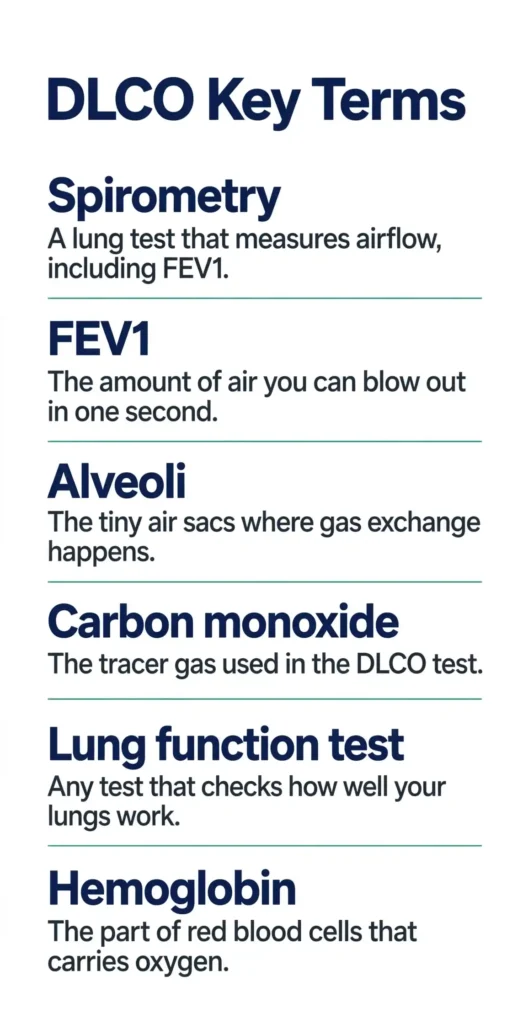
- Spirometry — a lung test that measures airflow, including FEV1.
- FEV1 — the amount of air you can blow out in one second.
- Alveoli — the tiny air sacs in your lungs where gas exchange happens.
- Carbon monoxide — the tracer gas used in the DLCO test.
- Lung function test — any test that checks how well your lungs work.
- Hemoglobin — the part of red blood cells that carries oxygen.
FAQs
What does DLCO stand for?
DLCO stands for Diffusing Capacity of the Lungs for Carbon Monoxide. It is a lung test that checks how well oxygen moves into your blood.
Is the DLCO test safe?
Yes. The test uses a very small amount of carbon monoxide, and the amount is safe. You breathe it in once and hold your breath for about 10 seconds.
How should I prepare for a DLCO test?
Do not smoke for 4 to 6 hours before the test. Do not exercise right before it. If you use extra oxygen, your clinic may ask you to stop it 10 minutes before, only if that is safe for you.
Does a DLCO test hurt?
No. You breathe through a mouthpiece with a nose clip on. The risks are very small. Some people feel light-headed for a short time.
What is a normal DLCO?
Results are given as a share of the value expected for a person of your age, sex, and height. Around 80 to 120 percent of that value is seen as normal. Ask your doctor about your own result.
Can DLCO be too high?
Yes. A high result can come from bleeding inside the air sacs, extra red blood cells, or asthma. Ask your doctor what your own result means.
How is DLCO different from spirometry?
Spirometry measures airflow. DLCO measures gas exchange. Doctors often use both tests together to find the cause of a lung problem.
See also
Conclusion
DLCO stands for Diffusing Capacity of the Lungs for Carbon Monoxide. It is a simple breath test that shows how well your lungs pass oxygen into your blood. If your doctor orders one, it helps them see your lung health more clearly. If you ever wondered what does DLCO stand for, now you know the answer.

Founder & Editor, Linktova. Arshad Ullah is the Founder & Editor at Linktova. He has previously worked on vocabulary websites and now leads the Linktova Team in explaining what abbreviations stand for — their full forms, meanings, and everyday use — in simple language.