FEV1 stands for Forced Expiratory Volume in 1 second.
It is a number from a lung function test. It shows how much air you can blow out in the first second of one hard breath. In other words, if you have ever asked what does FEV1 stand for, it is the number doctors use to check how well your lungs work.
Quick Reference
| Full form | Forced Expiratory Volume in 1 second |
| Pronounced | “eff-ee-vee-one” |
| Type | Initialism |
| Category | Medical & Healthcare |
Pronunciation
Say FEV1 as “eff-ee-vee-one”. Say each letter on its own, then say the number “one”.
Acronym or Initialism?
FEV1 is an initialism. You read it letter by letter, then the number. People often call such terms “acronyms” anyway, but the correct word here is initialism.
What Does FEV1 Stand For?
FEV1 is the amount of air you can force out of your lungs in one second. In fact, when people ask what does FEV1 stand for, they are asking about that first second of a hard blow. You take the deepest breath you can, then blow out as hard and fast as you can. The machine records how much air leaves in that first second.
Healthy lungs push most of their air out fast. For example, in healthy adults, more than 70% of the air leaves in the first second. If your airways are narrow, the air comes out slowly, so less leaves in that first second.
Your result is compared with a predicted value. That value comes from people of your age, height, and sex with healthy lungs. Therefore, a result of 80% of predicted or higher is generally seen as normal.
How FEV1 Works
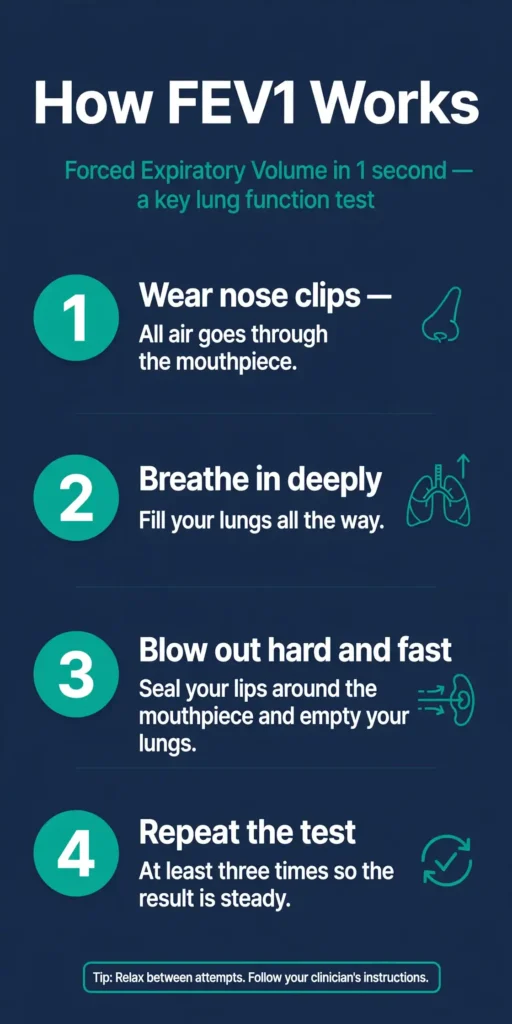
The test is called spirometry. It uses a machine called a spirometer, which measures the air you breathe out. So, if you have ever wondered what does FEV1 stand for, this is the test that measures it.
- Wear nose clips — they make sure all the air goes through the mouthpiece.
- Breathe in as deeply as you can — fill your lungs all the way.
- Blow out hard and fast — seal your lips around the mouthpiece and empty your lungs.
- Repeat the test — you do it at least three times so the result is steady.
Sometimes the test is done twice. For instance, the second time comes after a puff of a bronchodilator, a medicine that opens the airways. If your number rises a lot, the narrowing may be reversible, which points more toward asthma than COPD.
Before the test, avoid intense exercise for at least 30 minutes. In addition, your provider may ask you to stop breathing medicines for a short time. Wear loose clothing, and tell your provider if you are sick or if you smoke.
What the Numbers Mean
The key number is the FEV1/FVC ratio. FVC is the total air you can blow out in one full breath. Finally, the ratio shows what share of that breath left in the first second.
A ratio below 0.70 after a bronchodilator means the airflow is blocked. Doctors call this obstruction. Once obstruction is found, the FEV1 percent of predicted shows how severe it is:
- GOLD 1, mild — FEV1 is 80% of predicted or higher.
- Moderate (GOLD 2) — FEV1 is 50% to 79% of predicted.
- GOLD 3, severe — FEV1 is 30% to 49% of predicted.
- GOLD 4, very severe — FEV1 is below 30% of predicted.
These bands come from GOLD, the Global Initiative for Chronic Obstructive Lung Disease. However, a low FEV1 alone does not name a disease. Your doctor reads it with your symptoms and your history.
If your own result worries you, ask your doctor what it means for you. In short, this article gives general facts only, not a diagnosis.
Where Is FEV1 Used?
Doctors order spirometry in lung clinics and hospitals. For example, it checks a long cough, breathlessness, or wheezing. It also tracks COPD and asthma over time, to see if treatment is working.
What FEV1 Has Achieved
FEV1 gave doctors a simple number for airflow. Before it, lung tests measured only total volume, which could not show narrowing. Eventually, FEV1 showed how fast air leaves, so obstruction could be found early.
It also gave COPD a clear staging system. For example, doctors can sort mild from very severe disease and track change over time.
Where Did FEV1 Come From?
Spirometry began in 1846. A British surgeon named John Hutchinson built a spirometer and coined the term “vital capacity.” He measured the lungs of 2,130 people to set normal values.
About 100 years later, two French doctors changed the test. In 1947, Robert Tiffeneau and André Pinelli proposed the volume breathed out in one second.
The name “forced expiratory volume” came later, coined by the British Thoracic Society in 1957. Since then, FEV1 has been the main number in lung function tests.
FEV1 vs DLCO
Both come from lung function tests, but they measure different things. FEV1 measures airflow — how fast air leaves your lungs. DLCO measures gas transfer — how well oxygen passes from your lungs into your blood.
The DLCO test uses a small, safe amount of carbon monoxide as a tracer gas. You breathe it in, hold your breath for about 10 seconds, then breathe out. The machine checks how much of the gas crossed into your blood.
Together, the two numbers tell doctors more than either one alone. A low FEV1/FVC ratio with a low DLCO points more toward emphysema. The same low ratio with a normal DLCO points more toward asthma or chronic bronchitis.
Key Terms
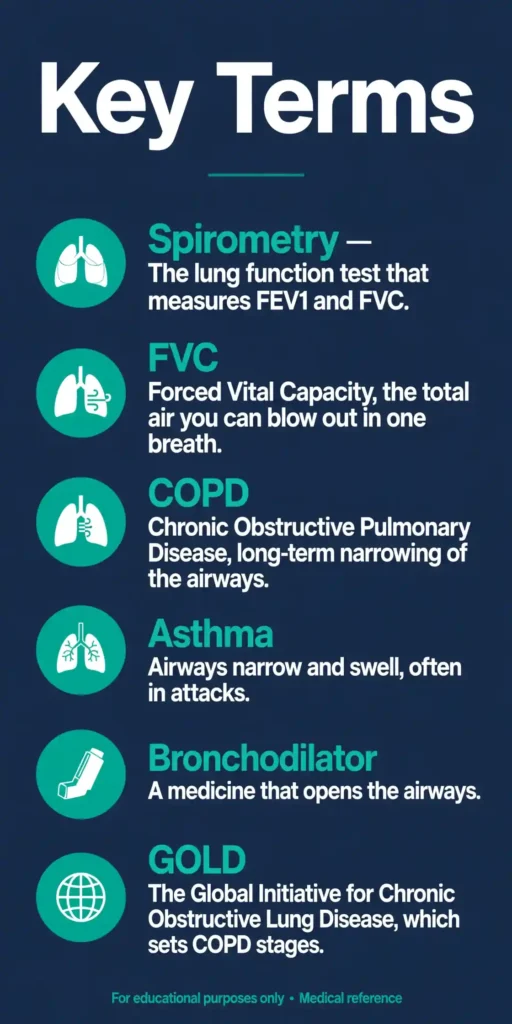
- Spirometry — the lung function test that measures FEV1 and FVC.
- FVC — Forced Vital Capacity, the total air you can blow out in one breath.
- COPD — Chronic Obstructive Pulmonary Disease, long-term narrowing of the airways.
- Asthma — a condition where the airways narrow and swell, often in attacks.
- Bronchodilator — a medicine that opens the airways.
- GOLD — the Global Initiative for Chronic Obstructive Lung Disease, which sets COPD stages.
FAQs
What does FEV1 stand for?
FEV1 stands for Forced Expiratory Volume in 1 second. It is the air you can force out of your lungs in the first second of a hard breath.
What is a normal FEV1?
A normal FEV1 is usually 80% or more of the predicted value for your age, height, and sex. Your doctor compares your number with that predicted value.
What does a low FEV1 mean?
A low FEV1 means air leaves your lungs more slowly than expected. It can point to narrowed airways, as in asthma or COPD. Only your doctor can say what it means for you.
Can FEV1 improve?
It can rise with treatment, such as a bronchodilator in asthma. Stopping smoking also helps protect it. Ask your doctor what can help in your case.
How long does an FEV1 test take?
The blowing part takes only a few minutes. A full spirometry visit can take 15 to 45 minutes, because the test is repeated and rest breaks are included.
Can I measure my FEV1 at home?
No. FEV1 needs a spirometer in a clinic. You can check your peak flow at home, which is a simpler blow test.
Does an FEV1 test hurt?
No, it is not painful. Some people feel dizzy or lightheaded during the test, and you can take breaks.
See also
Conclusion
FEV1 stands for Forced Expiratory Volume in 1 second. It is a simple number that shows how fast air leaves your lungs. In conclusion, now that you know what does FEV1 stand for, remember: if your result is low, it is a sign to talk with your doctor — not a diagnosis on its own.

Founder & Editor, Linktova. Arshad Ullah is the Founder & Editor at Linktova. He has previously worked on vocabulary websites and now leads the Linktova Team in explaining what abbreviations stand for — their full forms, meanings, and everyday use — in simple language.