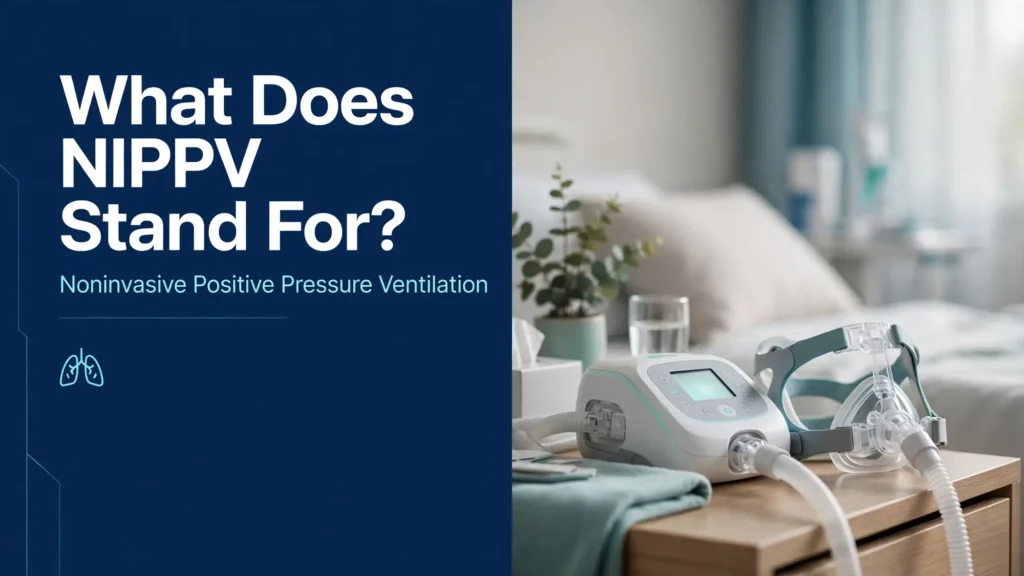
NIPPV stands for Noninvasive Positive Pressure Ventilation.
It is a way to help you breathe without a breathing tube. A machine pushes air through a mask that fits over your nose or mouth. In short, if you are wondering what does NIPPV stand for, it is breathing help through a mask, with no tube.
Quick Reference
| Full form | Noninvasive Positive Pressure Ventilation |
| Pronounced | “en-eye-pee-pee-vee” |
| Type | Initialism |
| Category | Medical & Healthcare |
Pronunciation
Say NIPPV as “en-eye-pee-pee-vee”. Say each letter on its own.
Acronym or Initialism?
NIPPV is an initialism. You read it letter by letter, not as one word. People often call such terms “acronyms” anyway, but the correct word here is initialism.
What Does NIPPV Stand For?
When people ask what does NIPPV stand for, the answer is breathing support that uses a mask, not a tube. For example, a machine sends pressurised air into your airways. As a result, the air helps your lungs take in oxygen and push out carbon dioxide.
The word “noninvasive” is the key part. In other words, it means nothing goes inside your body. The mask sits on your face. In addition, you can still talk and eat while you wear it.
You may have seen the letters NIPPV on a hospital chart and asked what does NIPPV stand for. The short answer is above.
Two Meanings — What Does NIPPV Stand For?
Most of the time, NIPPV means Noninvasive Positive Pressure Ventilation. This is the general meaning for adults. It covers the two main forms, CPAP and BiPAP.
In baby care, the same letters can mean something more exact. There, NIPPV stands for Nasal Intermittent Positive Pressure Ventilation. It gives extra breaths to premature babies through small nose prongs.
So the letters stay the same, but the setting changes the words. In this article, NIPPV means the general adult form, unless we say otherwise.
How NIPPV Works
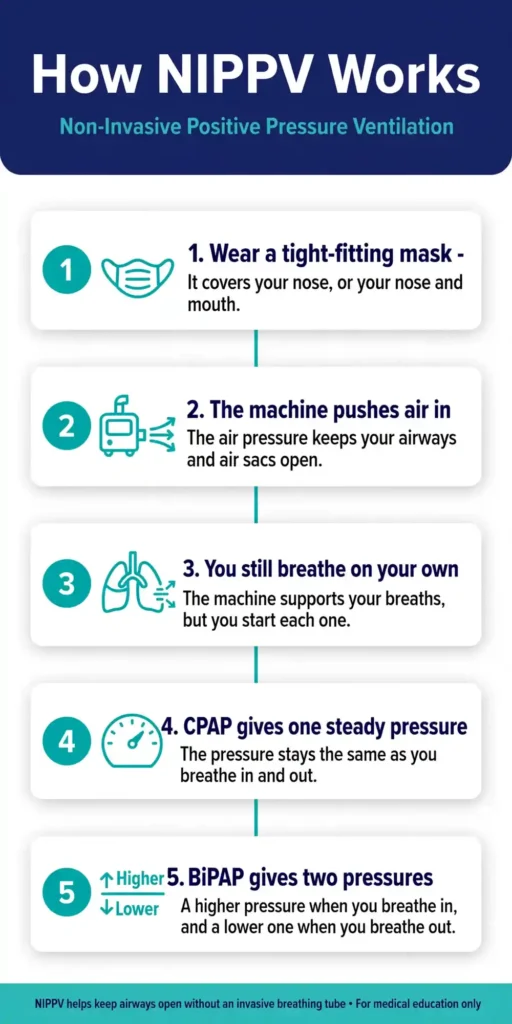
First, a mask fits tightly over your nose or over your nose and mouth. Next, a machine pushes air through the mask at a set pressure. As a result, the pressure holds your airways open and takes some of the work off your breathing muscles.
- Wear a tight-fitting mask — it covers your nose, or your nose and mouth.
- The machine pushes air in — the air pressure keeps your airways and air sacs open.
- You still breathe on your own — the machine supports your breaths, but you start each one.
- CPAP gives one steady pressure — the pressure stays the same as you breathe in and out.
- BiPAP gives two pressures — a higher pressure when you breathe in, and a lower one when you breathe out.
BiPAP is a brand name. In other words, the general word is BPAP. Alternatively, some people use a helmet instead of a mask if the mask does not fit well.
CPAP mainly helps with oxygen. For example, it keeps the airways open so oxygen can reach your blood. Similarly, BiPAP does that too, and in addition, it also helps clear carbon dioxide from your lungs.
Where Is NIPPV Used?
Doctors use NIPPV in hospitals for people who struggle to breathe. For example, the main uses are COPD flare-ups, fluid on the lungs from heart failure, and breathing failure in people with weak immune systems. In addition, doctors also use it to help people come off a breathing tube after COPD treatment.
You may also meet NIPPV at home. For instance, CPAP is the common home treatment for obstructive sleep apnoea. Similarly, BiPAP is used at home for long-term breathing problems, such as obesity-hypoventilation syndrome or muscle and chest wall disease.
A Note on Safety
NIPPV is a medical treatment, and doctors set it up and watch over it. Therefore, never start it on your own, and never change the pressure yourself. If breathing gets worse, get medical help right away.
Some people cannot use NIPPV. For example, people who are unconscious, who are vomiting, who have a face injury, or whose blood pressure or heart rhythm is unstable cannot use it. In the end, a doctor decides.
What NIPPV Has Achieved
NIPPV has changed how hospitals treat breathing failure. For example, in COPD flare-ups, it lowers the need for a breathing tube. In addition, it also shortens hospital stays.
It lowers the risk of lung infection too. For example, a breathing tube can let germs into the lungs, and NIPPV avoids that tube. As a result, for many patients, it means faster recovery and less time in intensive care.
Where Did NIPPV Come From?
Breathing help through a mask is older than CPAP. For instance, it was tried as early as the 1800s, and again in the 1930s and 1940s, but it stayed rare until CPAP came along. The story starts with CPAP. In 1981, Professor Colin Sullivan in Sydney, Australia, published the first results.
His machine used a mask and a motor to push air into the airways of five people with severe sleep apnoea. As a result, it worked, and the airway stayed open all night.
Before that, the main treatment for severe sleep apnoea was surgery on the windpipe. In contrast, CPAP gave people a treatment without surgery. Later, BiPAP machines followed, in the late 1980s and 1990s, and became common in hospitals.
Over time, doctors moved NIPPV beyond sleep. As a result, it became a first-line hospital treatment for COPD flare-ups and heart failure. That is the change that matters most.
NIPPV vs Invasive Ventilation
Invasive ventilation uses a breathing tube. Doctors place the tube in the windpipe, and a machine breathes for you. It takes full control, and you need sedation.
NIPPV works the other way. In contrast, you keep breathing on your own, with help from a mask. In addition, you can talk and eat, and the infection risk is lower.
But NIPPV does not fit every case. It cannot protect your airway, and it fails when breathing failure is severe. If it does not work within about 2 hours, doctors switch to a breathing tube.
Key Terms
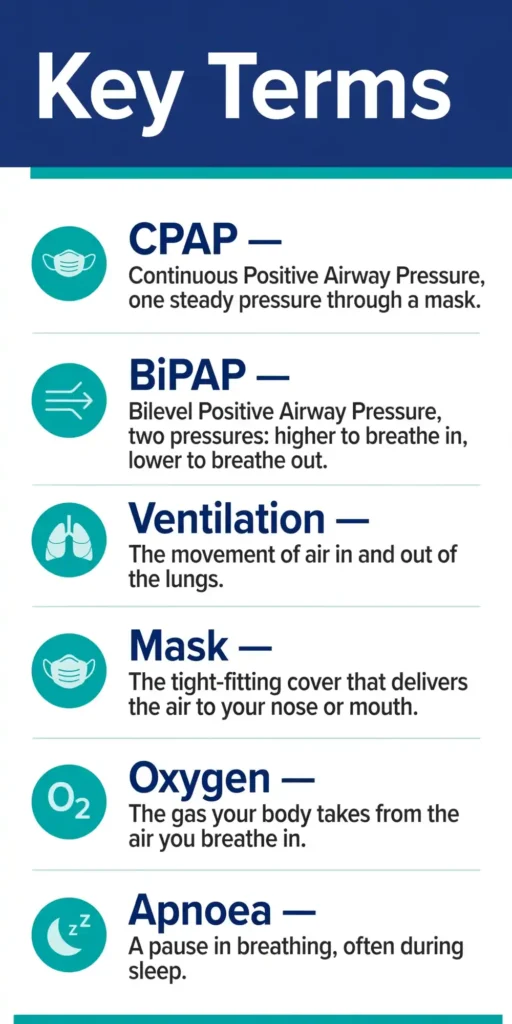
- CPAP — Continuous Positive Airway Pressure, one steady pressure through a mask.
- BiPAP — Bilevel Positive Airway Pressure, two pressures: higher to breathe in, lower to breathe out.
- Ventilation — the movement of air in and out of the lungs.
- Mask — the tight-fitting cover that delivers the air to your nose or mouth.
- Oxygen — the gas your body takes from the air you breathe in.
- Apnoea — a pause in breathing, often during sleep.
FAQs
What does NIPPV stand for?
NIPPV stands for Noninvasive Positive Pressure Ventilation. It is breathing support through a mask, with no breathing tube.
Is NIPPV the same as a ventilator?
Not quite. A ventilator is the machine. NIPPV is a way of using it through a mask.
Invasive ventilation uses the same kind of machine with a breathing tube instead.
Can you use NIPPV at home?
Yes, for some conditions. CPAP at home is common for sleep apnoea.
BiPAP at home is used for long-term breathing problems. A doctor decides if home use fits you.
Does NIPPV hurt?
It should not hurt, but the mask can feel strange at first. Some people get a dry mouth or a sore nose. Tell your care team if the mask hurts or air leaks around it.
Is NIPPV the same as BiPAP?
No. NIPPV is the general way of giving breathing help through a mask. BiPAP is one form of it — it gives two pressures, higher when you breathe in and lower when you breathe out.
Is NIPPV the same as CPAP?
No. CPAP is one form of NIPPV. It gives one steady pressure. NIPPV is the general name, and it also includes BiPAP, which gives two pressures.
What is NIPPV used for?
Doctors use it in hospitals for COPD flare-ups, fluid on the lungs from heart failure, and breathing failure in people with weak immune systems. At home, CPAP is used for sleep apnoea.
What is the difference between NIPPV and IPPV?
NIPPV gives breathing help through a mask, with no tube. IPPV (invasive positive pressure ventilation) uses a breathing tube in the windpipe, and the machine breathes for you.
Who cannot use NIPPV?
People who cannot protect their own airway, who are vomiting, who have a face injury, or whose blood pressure or heart rhythm is unstable. A doctor decides.
See also
Conclusion
NIPPV stands for Noninvasive Positive Pressure Ventilation. So, when you ask what does NIPPV stand for, remember that it helps you breathe through a mask, with no tube in your windpipe. For many people with COPD, heart failure or sleep apnoea, it is the gentler way to get the air they need.

Founder & Editor, Linktova. Arshad Ullah is the Founder & Editor at Linktova. He has previously worked on vocabulary websites and now leads the Linktova Team in explaining what abbreviations stand for — their full forms, meanings, and everyday use — in simple language.