
PGDE stands for Professional Graduate Diploma in Education.
It is the main graduate route into teaching in Scotland. You take it after you already have a degree. It turns a graduate into a qualified teacher.
Quick Reference
| Item | Detail |
|---|---|
| Full form | Professional Graduate Diploma in Education |
| Also stands for | Postgraduate Diploma in Education (Singapore and England — see the comparison below) |
| What it is | A postgraduate teacher-training qualification |
| Where it is used most | Scotland |
| Length (Scotland, full-time) | 36 weeks |
| Split | 18 weeks on campus, 18 weeks on school placement |
| Regulator | General Teaching Council for Scotland (GTCS) |
| After the course | Provisional registration with the GTCS, then a probationary year |
| Acronym or initialism | Initialism — read letter by letter as “pee-gee-dee-ee” |
Pronunciation
PGDE is said letter by letter: pee-gee-dee-ee.
It is an initialism, not an acronym. You do not say it as one word.
What Does PGDE Stand For?
PGDE stands for Professional Graduate Diploma in Education.
The name tells you three things. “Professional” means it trains you for a profession. “Graduate” means you need a degree first. “Diploma in Education” means it is a diploma-level teaching qualification.
It is not a degree in a school subject. You study your subject in your first degree. The PGDE then teaches you how to teach it.
What Is PGDE?
PGDE is Scotland’s main way for graduates to become teachers.
It prepares you to teach in primary or secondary schools. A PGDE Primary trains you for pupils aged about 3 to 12. A PGDE Secondary trains you for pupils aged about 11 to 18.
The course is regulated by the General Teaching Council for Scotland (GTCS) and the Scottish Government. That matters. You must register with the GTCS before you can teach in a Scottish local authority school.
The PGDE is also recognised outside Scotland. But if you want to teach in another country, check that country’s rules first. Each place has its own system.
PGDE in Scotland, Singapore and England
PGDE does not mean the same thing everywhere. The letters are the same. The qualification is not.
| Meaning | Where | Full form | Length |
|---|---|---|---|
| PGDE (dominant) | Scotland | Professional Graduate Diploma in Education | 36 weeks full-time |
| PGDE | Singapore | Postgraduate Diploma in Education | 16 months full-time (PE: 2 years) |
| PGDE | England | Postgraduate Diploma in Education | About 1 year full-time |
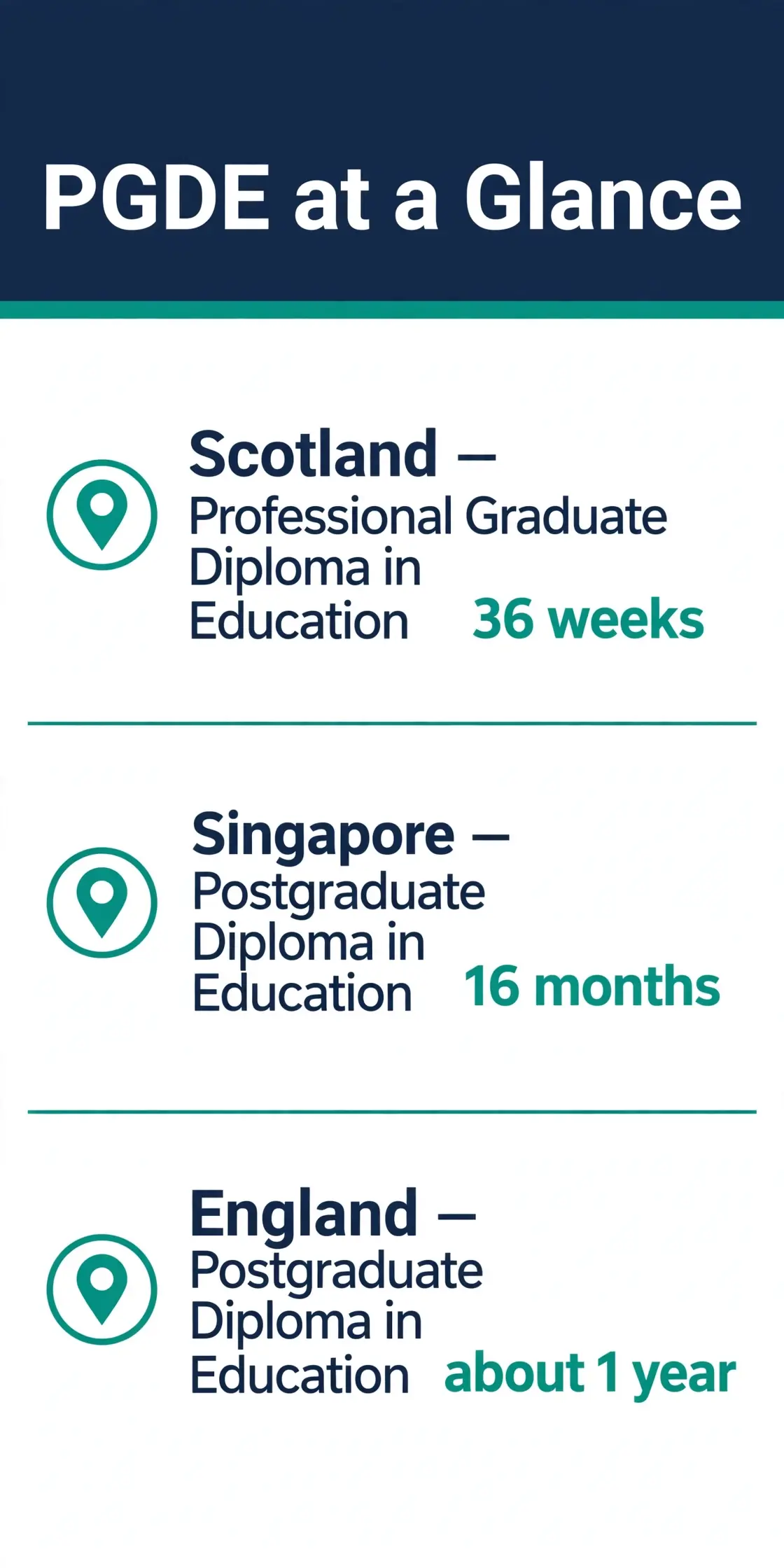
In Scotland, the PGDE is the standard graduate route. In Singapore, the PGDE is run by the National Institute of Education at Nanyang Technological University (NTU). It prepares graduates to teach at primary, secondary or junior college level. The Singapore course is sponsored by the Ministry of Education (MOE).
In England, a PGDE is a Postgraduate Diploma in Education. It is like a PGCE, but with more academic work and more Master’s-level credits.
This article focuses on the Scottish PGDE. That is the meaning most people search for.
History and Origin
The PGDE has a short, clear history in Scotland.
Scotland used to offer the PGCE, the Postgraduate Certificate in Education. A review found that the PGCE was really equal to a postgraduate diploma, not a certificate. A certificate is a lower level than a diploma.
So the PGCE in Scotland was renamed the Professional Graduate Diploma in Education (PGDE) from 2005 to 2006. The exact year depended on the university. The content stayed the same as the old PGCE.
How it has changed over time
The name changed, but the idea did not. The PGDE is still a one-year graduate route into teaching.
What has changed is the credit system. Today, the course carries Master’s-level credits. At Strathclyde, you can achieve up to 80 Master’s-level credits. Those credits can count towards a Master’s degree later. The PGDE itself is still not a Master’s degree.
How PGDE Works
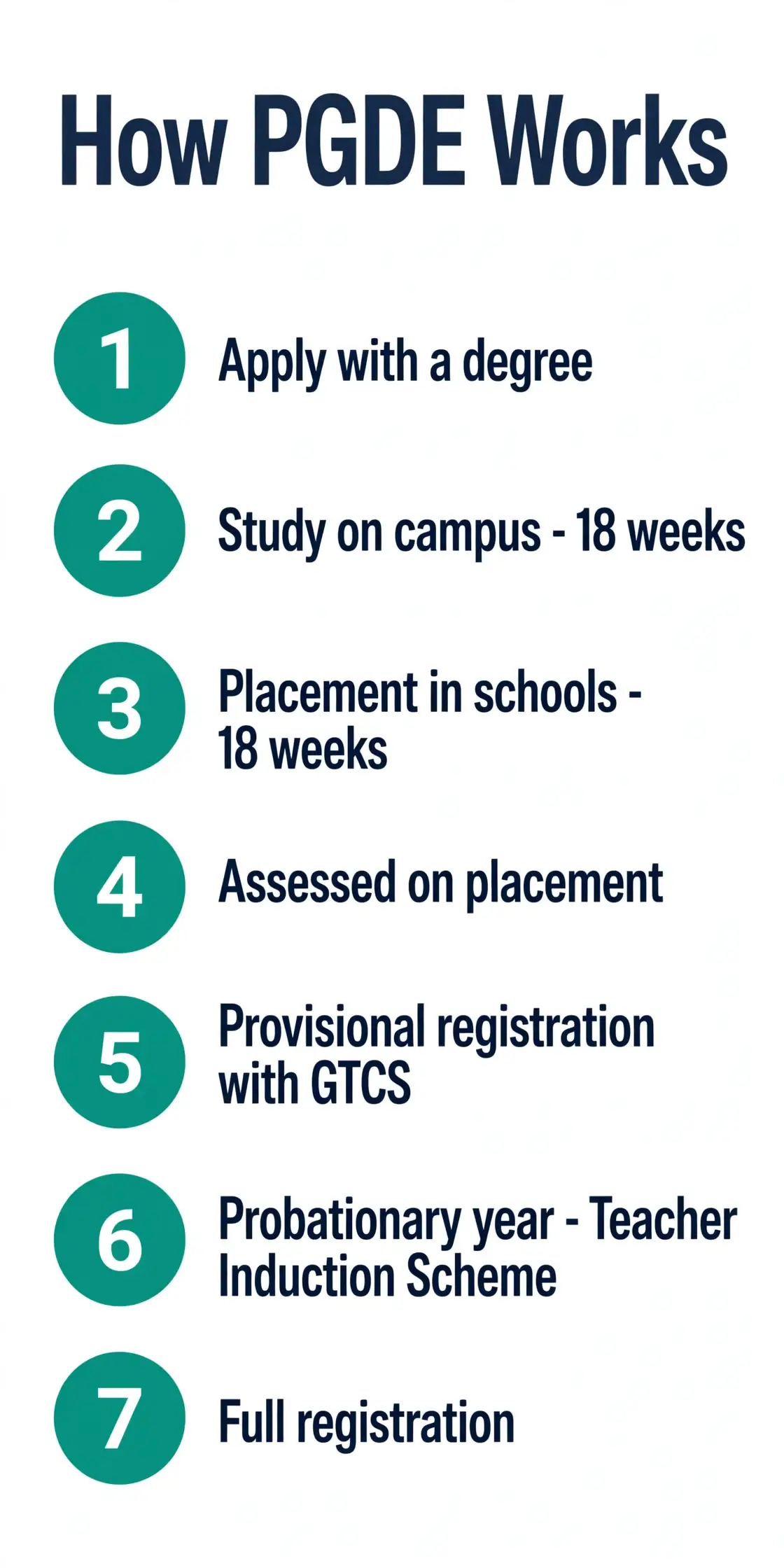
The Scottish PGDE follows the same steps at every university. Here is how it works.
- Apply with a degree. You need a degree in a relevant subject. For secondary teaching, you usually need 80 SCQF credits in that subject. You also need Higher English and National 5 Maths.
- Study on campus. You spend 18 weeks at university. You study three modules: Education Studies and Professional Values, Professional Learning Through Enquiry, and Professional Skills.
- Go on placement. You spend 18 weeks in schools in Scotland. Secondary students do two placements in two schools. Primary students do three placements in three schools.
- Get assessed on placement. You are assessed all through your placement. You must meet the GTCS Standard for Provisional Registration.
- Register provisionally. After the course, you register provisionally with the GTCS.
- Complete a probationary year. Eligible graduates join the Teacher Induction Scheme (TIS). It is a guaranteed, paid, one-year post in a Scottish school. Others follow the Flexible Route and find their own post.
- Gain full registration. After one satisfactory probationary year, the GTCS awards full registration. Then you are a fully registered teacher.
Where is PGDE used?
- Primary schools in Scotland — PGDE Primary, for pupils aged about 3 to 12.
- Secondary schools in Scotland — PGDE Secondary, for one subject (or two, with dual qualification).
- Singapore schools — the Singapore PGDE, for primary, secondary and junior college teaching.
- England — the England PGDE, as a more academic alternative to the PGCE.
PGDE vs PGCE
This is the most common confusion about PGDE. The two are close cousins, not twins.
| Item | PGDE (Scotland) | PGCE (England, Wales, Northern Ireland) |
|---|---|---|
| Full form | Professional Graduate Diploma in Education | Postgraduate Certificate in Education |
| Where | Scotland (mainly) | England, Wales and Northern Ireland |
| Registration | GTCS provisional registration | Qualified Teacher Status (QTS) |
| Length | 36 weeks full-time | About 1 academic year full-time |
| After the course | Probationary year, then full GTCS registration | Induction year in England |
| Master’s credits | Up to 80 at Strathclyde (varies by university) | Up to 60 |
The simple rule is this. If you want to teach in Scotland, take the PGDE. If you want to teach in England, take the PGCE. Each one fits its own system.
What PGDE Cannot Do
- It is not a Master’s degree. It carries Master’s-level credits, but the PGDE on its own is a diploma, not a Master’s.
- It does not give you QTS. Scotland does not use Qualified Teacher Status. It uses GTCS registration instead.
- It does not let you teach anywhere automatically. The qualification is recognised in many places, but you must check the rules of the country or region where you want to teach.
- It is not always part-time. At Strathclyde, the PGDE can be studied part-time over two years for most secondary subjects, but not for Physical Education or Technological Education.
Key Terms
- PGDE — Professional Graduate Diploma in Education, Scotland’s graduate route into teaching.
- GTCS — General Teaching Council for Scotland, the regulator that registers teachers in Scotland.
- PGCE — Postgraduate Certificate in Education, the main graduate teaching route in England, Wales and Northern Ireland.
- QTS — Qualified Teacher Status, the status needed to teach in most state schools in England.
- SCQF — Scottish Credit and Qualifications Framework, the system that measures the level and credits of Scottish qualifications.
- Teacher Induction Scheme (TIS) — the GTCS scheme that gives eligible new teachers a guaranteed, paid, one-year probationary post in Scotland.
Myth vs Fact
Myth: A PGDE is a Master’s degree.
Fact: No. It is a diploma. It carries Master’s-level credits that can count towards a Master’s later, but the PGDE itself is not a Master’s.
Myth: PGDE and PGCE are the same thing.
Fact: They are close, but not the same. The PGDE is Scotland’s route and leads to GTCS registration. The PGCE is England’s route and leads to QTS.
PGDE Used in a Sentence
- “After her history degree, she took a PGDE to become a secondary school teacher in Scotland.”
- “He finished his PGDE in June and started his probationary year in August.”
FAQs
How long does a PGDE take?
In Scotland, the full-time PGDE takes 36 weeks. That is 18 weeks on campus and 18 weeks on placement. Part-time study over two years is possible for most secondary subjects.
Is a PGDE the same as a PGCE?
No, but they are close. The PGDE is Scotland’s equivalent of the PGCE. The PGDE leads to GTCS registration. The PGCE leads to Qualified Teacher Status (QTS) in England, Wales and Northern Ireland.
Is PGDE a Master’s degree?
No. The PGDE is a diploma, not a Master’s degree. It does carry Master’s-level credits. At Strathclyde, you can achieve up to 80 Master’s-level credits, which can count towards a Master’s later.
What happens after a PGDE?
You register provisionally with the GTCS. Then you complete a probationary year of teaching. Eligible graduates do this through the Teacher Induction Scheme, a guaranteed paid post for one year. After a satisfactory year, you gain full registration.
What does PGDE stand for in Singapore?
In Singapore, PGDE stands for Postgraduate Diploma in Education. It is run by the National Institute of Education at NTU. The full-time course takes 16 months, except for Physical Education, which takes 2 years.
Conclusion
PGDE stands for Professional Graduate Diploma in Education. It is Scotland’s main graduate route into teaching.
In 36 weeks, it takes a graduate with a degree and turns them into a teacher. Half the time is spent at university. Half is spent teaching in a real school. After a probationary year, the teacher gains full registration with the GTCS.
Just remember to check which PGDE you mean. Scotland, Singapore and England all use the same letters for different courses.
Key takeaway: Before you apply, check which PGDE you mean — Scotland, Singapore or England. The full form, the length and the entry rules are different for each one.
See also
- ROTC Stands For – Full Form, Meaning and Examples — another Education, Exams & Student Organisations post: the Reserve Officers’ Training Corps.

Founder & Editor, Linktova. Arshad Ullah is the Founder & Editor at Linktova. He has previously worked on vocabulary websites and now leads the Linktova Team in explaining what abbreviations stand for — their full forms, meanings, and everyday use — in simple language.
Pingback: What Does NPQ Stand For? – Full Form, Meaning and Examples | Linktova