
What does BTU stand for? BTU stands for British Thermal Unit.
In simple words, one BTU is a small unit of heat. It is the heat needed to raise the temperature of one pound of water by one degree Fahrenheit. In short, BTU measures heat, not temperature itself. You will see it on air conditioners, heaters, and boilers, because it tells you how much heating or cooling a machine can do.
Quick Reference
| Item | Detail |
|---|---|
| Full form | British Thermal Unit |
| Short form | BTU |
| Read as | Initialism — “bee-tee-you” |
| Measures | Heat energy |
| One BTU | Heat to raise 1 lb of water by 1°F |
| In joules | About 1,055 joules |
| Main use | Rating heaters, coolers, and boilers |
| Not BTU | A temperature, a watt, or a brand name |
Pronunciation
Say BTU letter by letter: “bee-tee-you”. Do not say it as one word.
Acronym or Initialism?
BTU is an initialism. You read its letters one by one. The word “acronym” is often used loosely for both, but BTU is not spoken as a word.
What Is BTU?
BTU is a unit of heat energy. It comes from the old British system of units. Today, scientists use the joule as the standard unit of energy, but BTU is still common in the United States, especially for heating and cooling.
One BTU is a small amount of heat. A single match gives off about one BTU. A home heater, in contrast, gives off thousands of BTUs every hour. For this reason, BTU is often written with a time unit, as BTU per hour, or BTU/h. That rate tells you how fast a machine adds or removes heat.
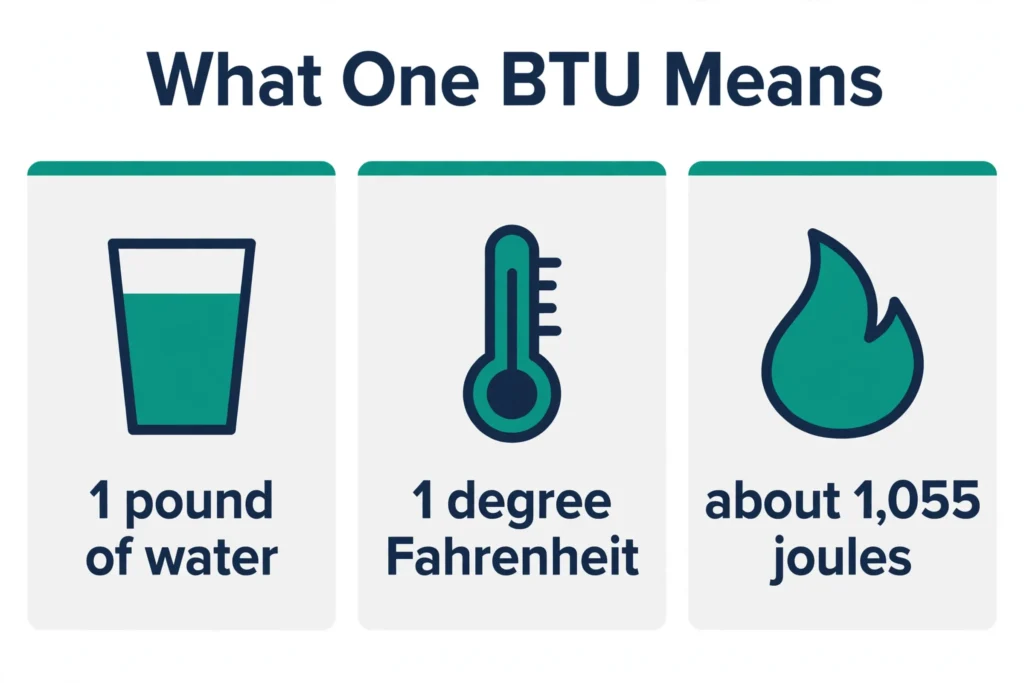
How BTU Works
- How much heat a fuel holds — natural gas, for example, is sold by the therm, and one therm equals 100,000 BTU.
- How much heat a machine can move — an air conditioner rated at 12,000 BTU/h can remove that much heat from a room every hour.
- How machines compare — two heaters with the same BTU/h rating can do about the same heating job, even if they use different fuels.
In short, BTU is a common yardstick for heat. It turns a vague idea — “this heater is strong” — into a number you can compare.
Where Is BTU Used?
BTU is used wherever heat matters, at home and at work.
- Air conditioners — rated in BTU/h; a bigger room needs a higher rating.
- Furnaces and heat pumps — rated in BTU/h for heating power.
- Boilers — rated in BTU/h for hot water and heating.
- Water heaters — rated in BTU/h for how fast they heat water.
- Gas stoves and ovens — burner power is often given in BTU/h.
- Energy bills — gas use is billed in therms, and one therm is 100,000 BTU.
You will also see BTU on energy labels, so you can compare the running cost of two machines before you buy one.
What BTU Has Achieved
BTU gave heating and cooling a shared language. Before a common unit, a buyer could not tell if one heater was stronger than another. With BTU, a buyer can compare an air conditioner, a furnace, and a heat pump on the same scale. That comparison helps people buy the right size, not too small and not too big.
BTU also helped the heating industry grow. Engineers, builders, and sellers all use the same unit, so a design made in one place works in another. In the United States, BTU is still the unit most people meet first when they buy an air conditioner or a heater. That simple, shared yardstick is its main achievement.
Where Did BTU Come From?
BTU has no single inventor. Its origin goes back to the early 19th century, when engineers first needed a unit for heat.
Thomas Tredgold, a British engineer, is credited with an early definition in his 1824 book on warming and ventilating buildings. His first definition used a cubic foot of water, raised by one degree Fahrenheit. Later, the definition was refined to one pound of water, which is the form used today.
Merriam-Webster gives the first known use of the term “British thermal unit” as 1865. Other histories note the term in use in the 1850s and 1880s, and BTU became a common engineering unit by 1897. So the unit grew over decades, not from one launch date. This post gives those dates as they are reported, and does not claim a single inventor or a single invention year.
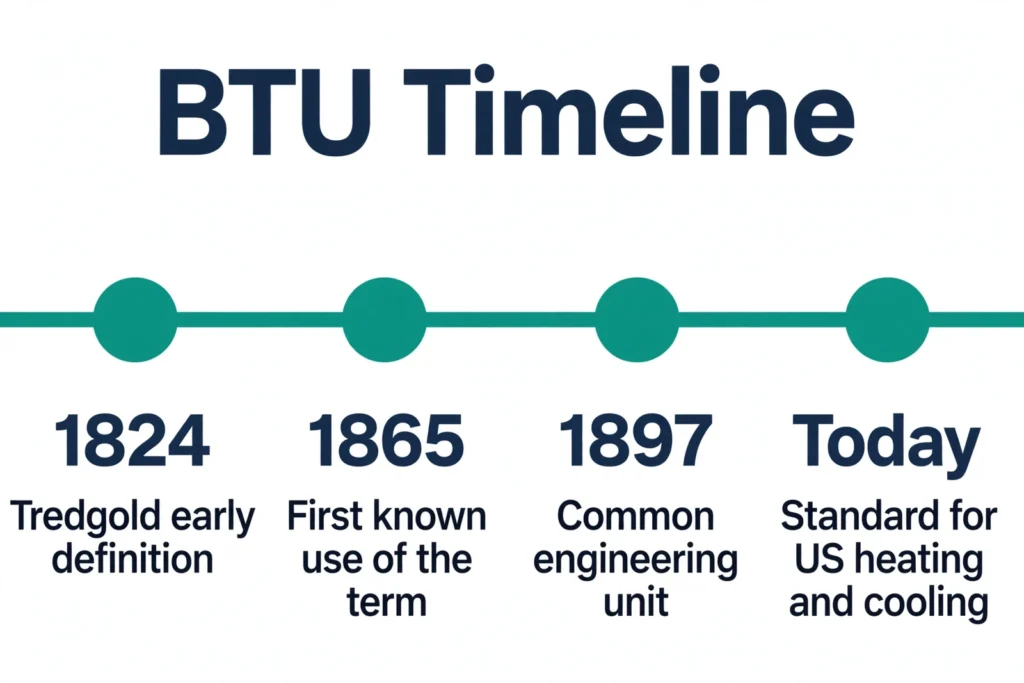
How BTU Has Changed Over Time
BTU changed in two clear ways. First, its definition was refined. It moved from a cubic foot of water to one pound of water, which made it simpler and more exact. Second, its role changed. Scientists now use the joule as the standard unit of energy, and one BTU equals about 1,055 joules. But BTU did not disappear. In the United States, it stayed the common unit for heating and cooling, because millions of machines, labels, and bills already used it.
Today, both units live side by side. A science textbook uses joules. A shop selling an air conditioner uses BTU. The heat is the same; only the unit changes.
BTU vs Joule and Calorie
These three units all measure energy, but they come from different systems.
- BTU: British Thermal Unit. Heat to raise 1 lb of water by 1°F. About 1,055 joules.
- Joule: The scientific standard unit of energy, used in the metric system. One BTU is about 1,055 joules.
- Calorie: The heat to raise 1 gram of water by 1°C. One BTU is about 252 calories.
In short, use BTU for US heating and cooling, joules for science, and calories for food and small heat amounts. To convert, remember: 1 BTU ≈ 1,055 joules, and 1 kilowatt-hour equals 3,412 BTU.
BTU/h and Tons
BTU/h means BTU per hour. It is a rate, not a total. A 12,000 BTU/h air conditioner removes 12,000 BTU of heat every hour it runs.
In air conditioning, you will also see “tons”. One ton of cooling equals 12,000 BTU/h. So a 2-ton air conditioner is rated at 24,000 BTU/h, and a 3-ton unit at 36,000 BTU/h. The word “ton” here does not mean weight. It comes from the cooling power of one ton of ice melting in a day.
A rough guide often cited by HVAC sources is about 20 BTU per square foot for cooling, and 40 to 45 BTU per square foot for heating. Treat that only as a rough guide. Proper sizing uses a full calculation, called a Manual J, and it depends on insulation, climate, windows, and other factors. Do not use the rough guide as an exact sizing formula.
Important: Treat the 20 BTU per square foot guide as a rough guide only. Proper sizing uses a full calculation, called a Manual J, and depends on insulation, climate, windows, and other factors.
Key Terms
- BTU — British Thermal Unit, the heat to raise 1 lb of water by 1°F.
- BTU/h — BTU per hour, a rate of heating or cooling.
- Ton (cooling) — one ton of cooling equals 12,000 BTU/h.
- Joule — the scientific standard unit of energy; one BTU is about 1,055 joules.
- Calorie — the heat to raise 1 gram of water by 1°C; one BTU is about 252 calories.
- Therm — a unit of gas energy equal to 100,000 BTU.
What BTU Cannot Do
BTU alone does not tell you if a machine is good. A high BTU rating means more heat, not better quality. A machine that is too big for a room can waste energy, switch on and off too often, and leave the room damp. A machine that is too small will run all day and still not cool the room.
BTU also does not tell you the running cost. Two machines with the same BTU rating can use very different amounts of electricity or gas. For cost, check the energy label and the efficiency rating, not just the BTU number.
Other Meanings of BTU
BTU most often means British Thermal Unit. No other common meaning of BTU was verified for this post, so none is listed here. If you see BTU in a heating, cooling, or energy context, it means British Thermal Unit.
Not To Be Confused With
- Watt: A watt measures power, or the rate of energy use. BTU measures heat energy. They are linked — 1 watt is about 3.412 BTU/h — but they are not the same unit.
- Temperature: Temperature, in degrees Fahrenheit or Celsius, tells you how hot something is. BTU tells you how much heat energy is involved.
- Ton (weight): A ton of cooling is 12,000 BTU/h. It is not a ton of weight.
Myth vs Fact
Myth: A bigger BTU rating is always better.
Fact: An oversized air conditioner wastes energy, switches on and off too often, and may not remove humidity well. The right size matters more than the biggest number.
Myth: BTU and watts are the same thing.
Fact: BTU measures heat energy, and watts measure power. They can be converted — 1 watt is about 3.412 BTU/h — but they are different units.
Myth: BTU is only for air conditioners.
Fact: BTU is used for furnaces, boilers, water heaters, gas stoves, and energy bills, not just air conditioners.
Used in a Sentence
- “This air conditioner is rated at 12,000 BTU per hour.”
- “BTU stands for British Thermal Unit, a unit of heat.”
- “A 2-ton air conditioner equals 24,000 BTU per hour.”
FAQs
What does BTU stand for?
BTU stands for British Thermal Unit. It is the heat needed to raise one pound of water by one degree Fahrenheit.
How many joules is one BTU?
One BTU is about 1,055 joules.
What does 12,000 BTU mean for an air conditioner?
It means the air conditioner can remove 12,000 BTU of heat per hour. That is also called one ton of cooling.
Is a higher BTU always better?
No. A unit that is too big wastes energy and may not cool well. The right size depends on the room, insulation, and climate.
See also
Conclusion: What Does BTU Stand For?
BTU stands for British Thermal Unit. It is a unit of heat energy, used to rate heaters, coolers, and boilers. One BTU is small, but thousands of BTU per hour can heat or cool a whole home.
That simple yardstick — one number, for heat, that buyers and engineers can share — is why BTU is still used today.

Founder & Editor, Linktova. Arshad Ullah is the Founder & Editor at Linktova. He has previously worked on vocabulary websites and now leads the Linktova Team in explaining what abbreviations stand for — their full forms, meanings, and everyday use — in simple language.