
You may have asked what does EST stand for — here is the short answer. In short, EST stands for Eastern Standard Time.
In other words, it is the winter time of the eastern United States and Canada. It is five hours behind Coordinated Universal Time, so its offset is UTC−5.
Quick Reference
| Item | Detail |
|---|---|
| Full form | Eastern Standard Time |
| Pronounced | “ee-ess-tee” |
| Type | Initialism |
| Category | Everyday Acronyms |
| UTC offset | UTC−5 (five hours behind UTC) |
| In use | First Sunday in November to second Sunday in March |
Other Meanings at a Glance
| # | Meaning | Where you meet it |
|---|---|---|
| 1 | Eastern Standard Time | Clocks, schedules and TV listings in the eastern US and Canada |
| 2 | est. — established / estimated | Company names (“Est. 1920”), prices and figures (“est. cost”) |
| 3 | Expressed Sequence Tag | Genetics and DNA research |
| 4 | Electroshock therapy | Medical use (older term) |
| 5 | Estonia | International car registration code |
Pronunciation
Say EST as “ee-ess-tee”. In other words, say each letter on its own.
Acronym or Initialism?
EST is an initialism. You read it letter by letter, not as one word. In fact, people often call such terms “acronyms” anyway, but the correct word here is initialism.
What Is EST?
EST is the standard time of the Eastern Time Zone. It is, in fact, the time used in the eastern United States and Canada during the colder months, when Daylight Saving Time is not in effect. In other words, if you ask what does EST stand for, the full form is Eastern Standard Time.
In fact, the offset is fixed. As a result, when it is 12:00 noon in UTC, it is 7:00 in the morning in EST.
For example, New York, Toronto, Washington, D.C., Miami and Boston all use EST in winter.
How EST Works
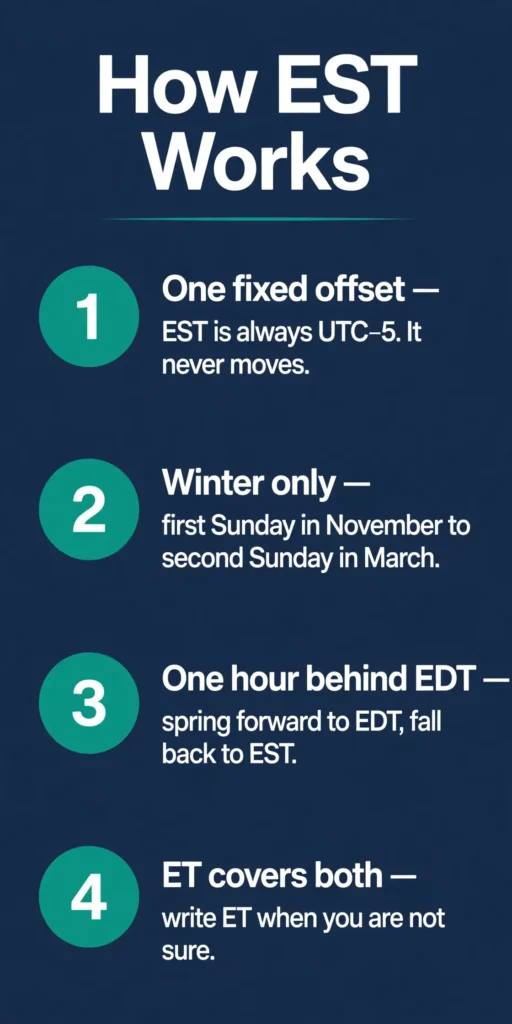
In short, EST sets all the clocks in one region to the same time. Here is the simple version:
- One fixed offset — EST is always UTC−5. It never moves.
- Winter only — in places that use Daylight Saving Time, EST runs from the first Sunday in November to the second Sunday in March.
- One hour behind EDT — when clocks “spring forward” in March, EST becomes EDT. When they “fall back” in November, EDT becomes EST again.
- ET covers both — if you are not sure which one applies, write ET (Eastern Time). It means whichever of EST or EDT is in use.
Where Is EST Used?
EST covers all or parts of 23 states in the eastern United States. In addition, it covers three provinces or territories in Canada.
Meanwhile, the same UTC−5 offset is used all year in places like Panama, Colombia and Peru, though they do not switch to daylight time.
Where Did EST Come From?
Before 1883, there was no standard time in North America. As a result, each town kept its own local solar time. There were more than 144 local times across the continent.
That made train timetables a mess. As a result, trains missed connections, and the confusion even caused collisions. The railroads fixed it themselves.
First, a Canadian railway engineer, Sandford Fleming, had proposed a global time zone system in 1876. Then, on October 11, 1883, railroad leaders met in Chicago and agreed on four standard time zones.
Finally, the new system took effect on November 18, 1883, a day called the “Day of Two Noons” because some places saw noon twice.
The Standard Time Act of 1918 made the time zones law in the United States. The Uniform Time Act of 1966 then set one national system for Daylight Saving Time.
EST vs EDT
EST and EDT are not two different time zones. In other words, they are two settings of the same Eastern Time Zone, one hour apart.
| EST | EDT | |
|---|---|---|
| Full form | Eastern Standard Time | Eastern Daylight Time |
| UTC offset | UTC−5 | UTC−4 |
| When | First Sunday in November to second Sunday in March | Second Sunday in March to first Sunday in November |
| Season | Autumn and winter | Spring and summer |
The most common mistake is writing “EST” all year round. For example, in July, New York is on EDT, not EST. If you are not sure, then write ET instead.
Other Meanings of EST
est. — Established or Estimated
With a small “e” and a full stop, “est.” is a written abbreviation. In short, it has two jobs.
“Est.” before a year means “established”. For example, you see it on shop signs and logos, as in “P. R. Jones & Co, Est. 1920”. In contrast, before a number, it means “estimated”, as in “est. cost, $2.4 million” or “est. population 14,000”.
The case and the full stop matter. “EST” in capitals with no full stop usually means the time zone. In contrast, “est.” in lower case with a full stop usually means established or estimated.
Expressed Sequence Tag
In genetics, EST stands for Expressed Sequence Tag. In other words, it is a short stretch of DNA copied from part of a gene.
Scientists proposed ESTs in 1991 as a way to find genes in the human genome. They are usually 200 to 500 letters of DNA code long. As a result, you will only meet this meaning in science papers and genetics courses.
Two more, in one line each
- Electroshock therapy — a medical abbreviation for electroshock therapy.
- Estonia — the international car registration code for Estonia.
Key Terms
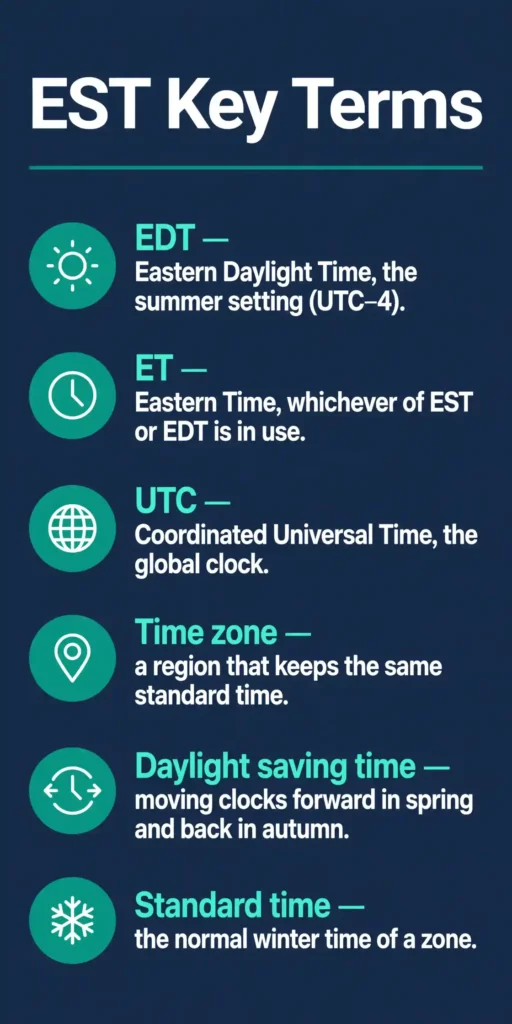
- EDT — Eastern Daylight Time, the summer setting of the Eastern Time Zone (UTC−4).
- ET — Eastern Time, the catch-all term for whichever of EST or EDT is in use.
- UTC — Coordinated Universal Time, the global clock all time zones measure from.
- Time zone — a region that keeps the same standard time.
- Daylight saving time — the practice of moving clocks forward one hour in spring and back in autumn.
- Standard time — the normal, winter time of a zone, without the daylight saving shift.
FAQs
What does EST stand for?
What does EST stand for? EST stands for Eastern Standard Time. In other words, it is the winter time of the eastern United States and Canada, five hours behind UTC (UTC−5).
Is EST the same as ET?
No. In short, EST is one setting of the Eastern Time Zone, used in winter.
ET (Eastern Time) is the general term. In other words, it means EST in winter and EDT in summer.
When is it EST and when is it EDT?
EST runs from the first Sunday in November to the second Sunday in March. Meanwhile, EDT runs for the rest of the year. For example, in 2026, clocks went forward on March 8 and back on November 1.
What does “est.” mean after a year or a price?
After a year, “est.” means “established”, as in “Est. 1920”. In contrast, before a figure, it means “estimated”, as in “est. cost, $2.4 million”. Finally, it is written in lower case with a full stop.
Conclusion
So, what does EST stand for? EST stands for Eastern Standard Time. In short, it is the UTC−5 winter clock of the US East Coast and eastern Canada, born with the railroads in 1883 and made law in 1918. Remember the simple rule: EST in winter, EDT in summer, and ET when you are not sure.

Founder & Editor, Linktova. Arshad Ullah is the Founder & Editor at Linktova. He has previously worked on vocabulary websites and now leads the Linktova Team in explaining what abbreviations stand for — their full forms, meanings, and everyday use — in simple language.