You may have asked what does FLTCIP stand for — here is the short answer. FLTCIP stands for Federal Long Term Care Insurance Program.
In short, FLTCIP is the long-term care insurance plan for the US federal family. It helps pay for care when you can no longer look after yourself. The US Office of Personnel Management (OPM) runs it.
Quick Reference
| Item | Detail |
|---|---|
| Full form | Federal Long Term Care Insurance Program |
| Pronounced | “eff-el-tee-see-eye-pee” |
| Type | Initialism |
| Category | Government & Public Services |
| Administered by | U.S. Office of Personnel Management (OPM) |
| Launched | 2002 |
Pronunciation
Say FLTCIP letter by letter: “eff-el-tee-see-eye-pee”. You do not say it as one word.
Acronym or Initialism?
FLTCIP is an initialism. You read it letter by letter, not as one word. People often call such terms “acronyms” anyway, but the correct word here is initialism. So, when someone asks what does FLTCIP stand for, spell it out letter by letter.
What Is FLTCIP?
FLTCIP is group long-term care insurance for federal workers, retirees, and their families. It pays for care you need when a long illness, injury, or disability stops you from doing daily tasks on your own. If you have ever wondered what does FLTCIP stand for, the answer is simple: it is the federal family’s long-term care insurance plan.
For example, these tasks include bathing, dressing, and eating. It also covers care for severe memory loss, such as Alzheimer’s disease.
Medicare and most health plans do not pay for this kind of long-term care. As a result, FLTCIP exists to fill that gap. You pay the full premium yourself, and the government pays none of it.
How FLTCIP Works
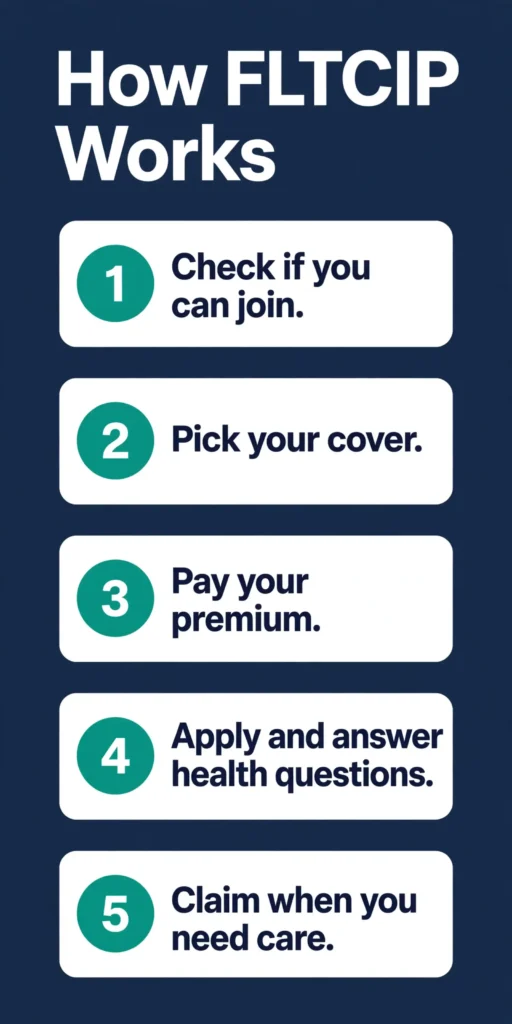
You join FLTCIP in five steps. Each step is simple, but the last one matters most right now.
- Check if you can join — most federal and US Postal Service workers and annuitants can apply. Active and retired members of the uniformed services can apply too. Certain family members, called qualified relatives, can also apply.
- Pick your cover — choose the daily benefit amount and how long benefits last. Also choose where care is given.
- Pay your premium — cover the full cost yourself. Your age at the time you join sets your rate.
- Apply and answer health questions — FLTCIP is medically underwritten. That means you must answer health questions, and the insurer can turn you down.
- Claim when you need care — when you need help with daily tasks, you file a claim. The plan pays for care at home, in assisted living, or in a nursing home.
However, one step is closed right now. OPM stopped new applications on December 19, 2022. It extended the freeze again on November 13, 2026, through December 2028.
Meanwhile, current members keep their cover if they keep paying. They cannot ask for more cover during the freeze. Claims are not affected.
Where Is FLTCIP Used?
FLTCIP is used across the United States. In other words, it covers federal workers and retirees wherever they live.
In addition, care can be given at home, in adult day care, in assisted living, in a nursing home, or in hospice.
What FLTCIP Has Achieved
After the first open season in 2002, FLTCIP became the largest employer-sponsored group long-term care plan in the country. It had nearly 200,000 members at that point.
In fact, about 267,000 people were enrolled in the plan, the most recent official figure from OPM in 2021. That is a small share of the millions of federal workers and retirees who can join.
It gave federal families a way to plan for care costs that health insurance does not cover. That planning is the point of the programme.
Where Did FLTCIP Come From?
Congress passed the Long-Term Care Security Act on September 19, 2000. The law, Public Law 106-265, told OPM to build a long-term care plan for the federal family.
Early enrolment ran from March 25 to May 15, 2002. A six-month open season followed, from July 1 to December 31, 2002. Finally, coverage began in October 2002.
A second open season ran from April 4 to June 24, 2011, for the FLTCIP 2.0 plan. It was the first open season since 2002.
Then the plan ran into trouble. At the same time, care costs kept rising, and fewer insurers stayed in the market. In 2016, enrollees faced an average premium rise of about 83 percent.
In November 2022, OPM issued a final rule to make the plan more stable. One month later, on December 19, 2022, it stopped new applications for two years. On November 13, 2024, OPM extended the freeze for another 24 months, through December 2026. On November 13, 2026, OPM extended it again for 24 months from December 19, 2026, through December 2028.
FLTCIP vs FEDVIP
Both are OPM programmes for federal workers, but they pay for different things. FLTCIP pays for long-term care. FEDVIP pays for dental and vision care.
However, their status is different too. FEDVIP takes new members during the annual open season. FLTCIP is closed to new applicants through December 2028.
Key Terms
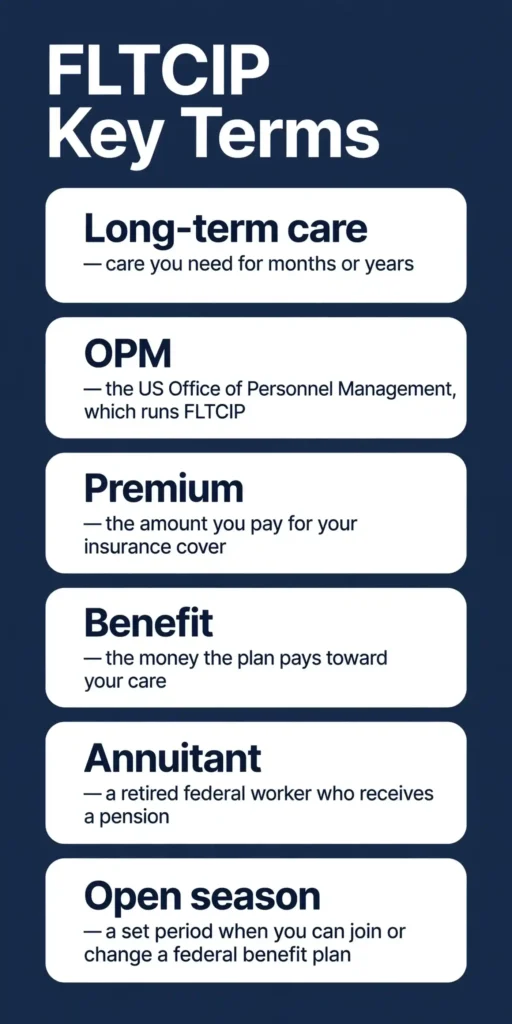
- Long-term care — care you need for months or years when you cannot look after yourself.
- OPM — the US Office of Personnel Management, which runs FLTCIP.
- Premium — the amount you pay for your insurance cover.
- Benefit — the money the plan pays toward your care.
- Annuitant — a retired federal worker who receives a pension.
- Open season — a set period when you can join or change a federal benefit plan.
See also
FAQs
What does FLTCIP stand for?
FLTCIP stands for Federal Long Term Care Insurance Program. It is the long-term care insurance plan for federal workers, retirees, and their families.
Can I apply for FLTCIP now?
No. OPM stopped new applications on December 19, 2022, and extended the freeze through December 2028. Finally, check ltcfeds.com for the latest status before you rely on that date.
Does FLTCIP pay for nursing home care?
Yes. It also pays for care at home, in assisted living, in adult day care, and in hospice.
Is FLTCIP the same as FEDVIP?
No. FLTCIP pays for long-term care. FEDVIP pays for dental and vision care. Both are OPM programmes for federal workers.
Conclusion
So what does FLTCIP stand for? FLTCIP stands for Federal Long Term Care Insurance Program. It is the federal family’s long-term care plan, run by OPM. Right now it is closed to new applicants through December 2028, but members who keep paying keep their cover.

Founder & Editor, Linktova. Arshad Ullah is the Founder & Editor at Linktova. He has previously worked on vocabulary websites and now leads the Linktova Team in explaining what abbreviations stand for — their full forms, meanings, and everyday use — in simple language.